
Gao Haichuan does not see himself as an academic turned entrepreneur. The founder of Qianjue Technology, who holds a doctorate from Tsinghua University, puts it more plainly:
“I have to consider commercial realities first, and technology second.”
Gao spotted a business opportunity in robot intelligence in 2019, while working in a Tsinghua laboratory, but waited four years to act. In 2023, he decided the technology was ready for engineering development and commercial deployment, left the university, and founded Qianjue.
Qianjue has completed a Series A+ funding round worth a nine-figure RMB sum, according to 36Kr. Participants include Oriza Rivertown, SSC Fund, KHK Fund, Innoangel Fund, Jingming Capital, and Future Marginal Ventures, alongside other financial and strategic investors. Maple Pledge, its longtime private equity fundraising adviser, also invested. The company has completed nine funding rounds since its founding.
From the outset, Gao took a different approach from companies expecting ChatGPT to solve the problems of deploying robots. His team had years of research behind it: key members settled on predictive world models as a research direction at Tsinghua in 2017 and performed well in international competitions. These models aim to predict how a robot’s surroundings might change and what its actions could do.
Qianjue initially said little about that research. While others imagined a future of general-purpose humanoids, Gao argued that robotics would have no “ChatGPT moment,” or in other words, no single technical breakthrough would cause the entire industry to take off overnight.
His view came from practical experience. Qianjue’s first orders were for restaurant, cleaning, and hotel service robots. Those products had identifiable demand.
Gao does not expect the data collection problem to be solved soon, so Qianjue pursues research and deployment in parallel. Its R&D team explores algorithms within a predictive world model framework built on a polynomial representation architecture. Its deployment team works with customers in hotels, retail, and home services, improving the technology through use.
“Customers will not pay an extra cent because we use an advanced predictive world model,” Gao told 36Kr. “They care whether the job gets done well, how often the robot fails, and whether it is worth the price.
CTO Zhang Tianren describes Gao as an “atypical Tsinghua University graduate.” Despite his years in research, Gao does not judge the venture solely by its papers or technical concepts, Zhang said. He rarely intervenes in specific technical designs, focusing instead on what the company should pursue, what it should avoid, and its long-term direction.
Gao is equally direct about robot intelligence suppliers that start making their own hardware, saying there is a strong possibility they are doing so to raise money. “That reflects the industry’s impatience. It is driven by capital rather than technology,” he said.
After attracting substantial investment, embodied intelligence companies face pressure to show results beyond pitch decks and exhibition demonstrations. “Even the best technology has no practical value if it cannot work in real applications and win customers’ acceptance,” Gao said.
The following transcript has been edited and consolidated for brevity and clarity.
36Kr: What is the most fundamental change you have seen in embodied intelligence this year?
Gao Haichuan (GH): An industry often develops fastest at this stage. It has moved beyond academia’s criteria for judging value.
Previously, people looked at one-off demonstrations and leaderboard rankings. Now they focus on deployment metrics: task success rates, continuous operating time, recovery from failures, deployment costs, and how quickly data can feed into improvements. Investors have changed their criteria too. A flashy demo is no longer enough to secure investment.
This is happening in China and overseas. Evaluation criteria are converging around these measures, with more discussion of systems engineering and how feedback from rare situations can improve performance.
No single architecture works in every setting, but a consensus is forming. This is no longer a software-as-a-service system delivered once and considered finished. It is a systems engineering undertaking in which models and feedback from real users continuously inform improvements during operation.
36Kr: Over the past year, attention seems to have shifted from end-to-end approaches to vision-language-action (VLA) models and then world models. How do you view the market’s response to new approaches and concepts?
GH: A proliferation of approaches is common across artificial intelligence, including multimodal and language models. But the foundations have not changed. More specifically, the approaches are not mutually exclusive. A system can often reuse its backbone network and feature representations simply by adding a decoder.
Short-term attention does not tell you whether an approach is viable. Each has strengths and weaknesses at different stages. New does not necessarily mean better. The real test is the market, starting with basic measures: data efficiency, sample efficiency, iteration costs, stability during extended operation, and generalization. These determine how far an approach can go.
36Kr: Qianjue has worked on predictive world models since day one. When did you settle on that direction?
GH: Interest in predictive world models in China took off after Yann LeCun started AMI Labs. Teams that had worked on the subject for years without much market attention came into the spotlight. Qianjue was one of them.
But in 2018, when the first paper in the world model field appeared, our team was already researching model-based control through ViZDoom competitions and performing well internationally.
We identified a long-term direction in which we had strong confidence. By the time world models became a popular topic this year, Qianjue had accumulated nearly a decade of technical work.
36Kr: How did the industry understand world models before the concept became popular? Why did Qianjue initially pass over the more mainstream VLA approach?
GH: When Qianjue was founded in 2023, the prevailing belief was that connecting ChatGPT to a humanoid robot would solve everything. That badly underestimated the scarcity of data. Collecting data from physical robots is expensive, both in time and in the damage that can occur. Algorithms therefore need very high sample efficiency to become commercially viable.
VLA models and world models are not complete opposites. VLA models have strengths in language understanding and generating actions directly. But relying solely on end-to-end policy learning can still require substantial data and create generalization challenges when data is scarce, environments change, or tasks fall outside the training distribution.
From the start, we decided against a model-free approach and chose predictive world models. That was not yet a consensus among companies developing robot intelligence.
With limited data, we want to improve how efficiently models use it, how well they generalize across settings, and how they make ongoing decisions in dynamic environments.
Another point matters. Random, changing disturbances in open environments are precisely where the transformer architecture is strong. A robot cannot simply generate one action from its current input. It has to update its understanding of the environment as new observations arrive. That requires modeling multimodal information and temporal relationships, as well as generalizing across settings.
By learning task-relevant state representations and how those states change, we want robots to predict the possible consequences of their actions and keep adjusting their decisions and plans. That would reduce dependence on fixed environments and existing data distributions. Together, these factors informed our choice.
36Kr: Why do manufacturers buy an external intelligence platform? What concerns do customers typically have?
GH: Their biggest concern is a conflict over market position. A manufacturer with business customers and its own robotics brand may find that its intelligence supplier also has a hardware brand. Even the possibility of competition will probably prevent a deal. That is a trust issue, not a technical one.
By supporting different robot forms, we want to reduce duplicated R&D at manufacturers and the cost of adapting intelligence to their hardware, helping partners bring products to market faster. We do not want to compete with their brands or for their end customers.
Making hardware may have particular value in raising funds in China. At some stages, it can even give a company another chance to survive. That reflects the industry’s impatience. It is driven by capital rather than technology.
RELATED ARTICLE
36Kr: Robots can perform well in laboratory demos, only to falter in the physical world. What is the biggest obstacle to replicating commercial deployments at scale?
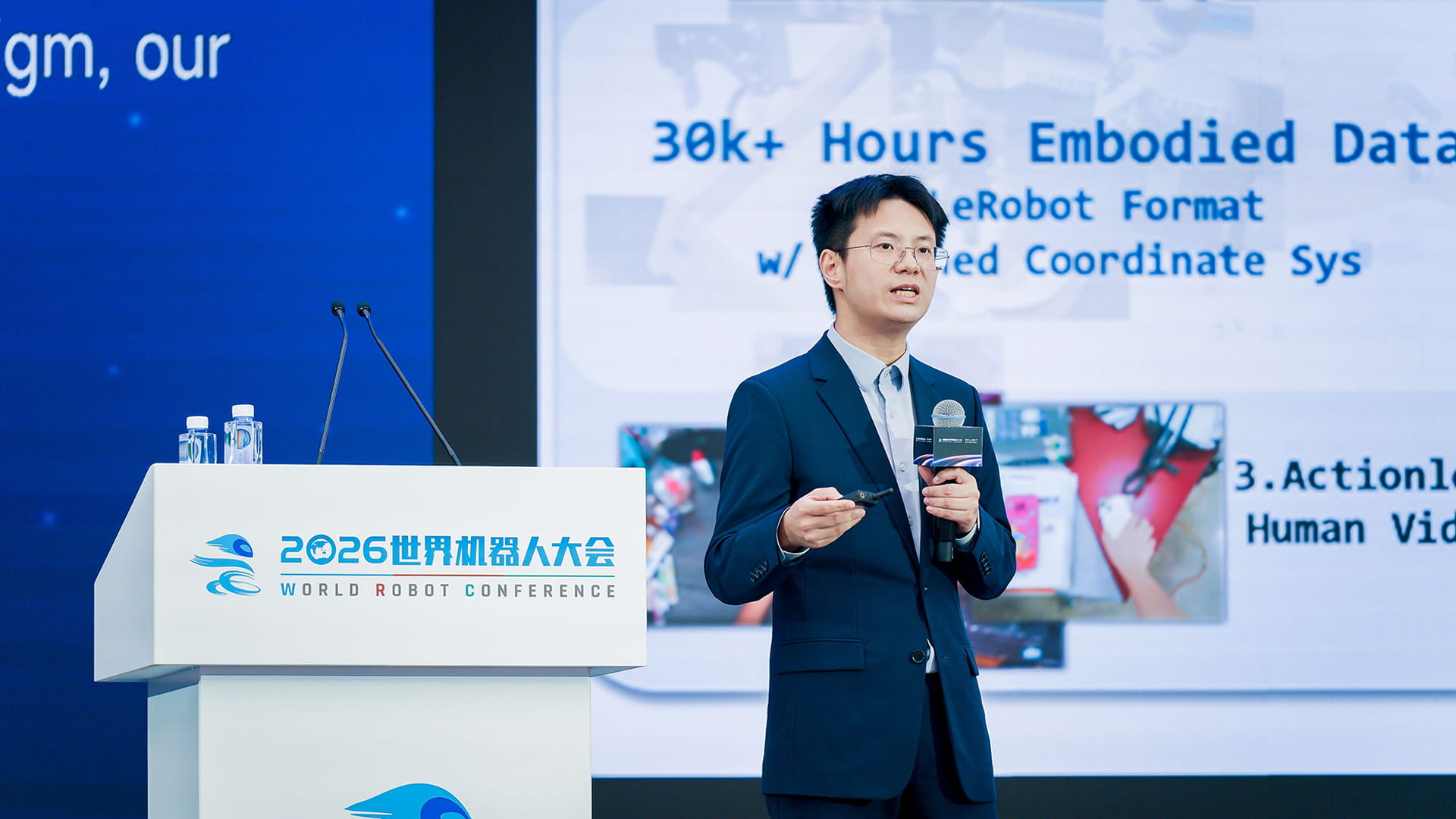
GH: After years of development, algorithms are relatively capable. The real bottleneck is data. Of the three ingredients, computing power, algorithms, and data, the first two are largely ready. Data supply is slowing progress.
Robotics faces a distinctive shortage. Data on physical interactions has to be actively collected by robots. That is very different from large language models, which can draw on decades of publicly available internet text. Robotics has not had a comparable period of widespread robot use in which enormous datasets of physical interactions could accumulate.
Without that foundation, the industry placed more hope in algorithms and computing power. But it cannot get around the data shortage. It needs new solutions.
That is why we have to recognize that robotics will have no “ChatGPT moment.” No single technical breakthrough will suddenly cause the entire industry to take off. Progress will come from individual real-world applications, with market adoption building gradually.
36Kr: How do you distinguish capabilities that can be reused across different robot bodies from those that cannot be transferred?
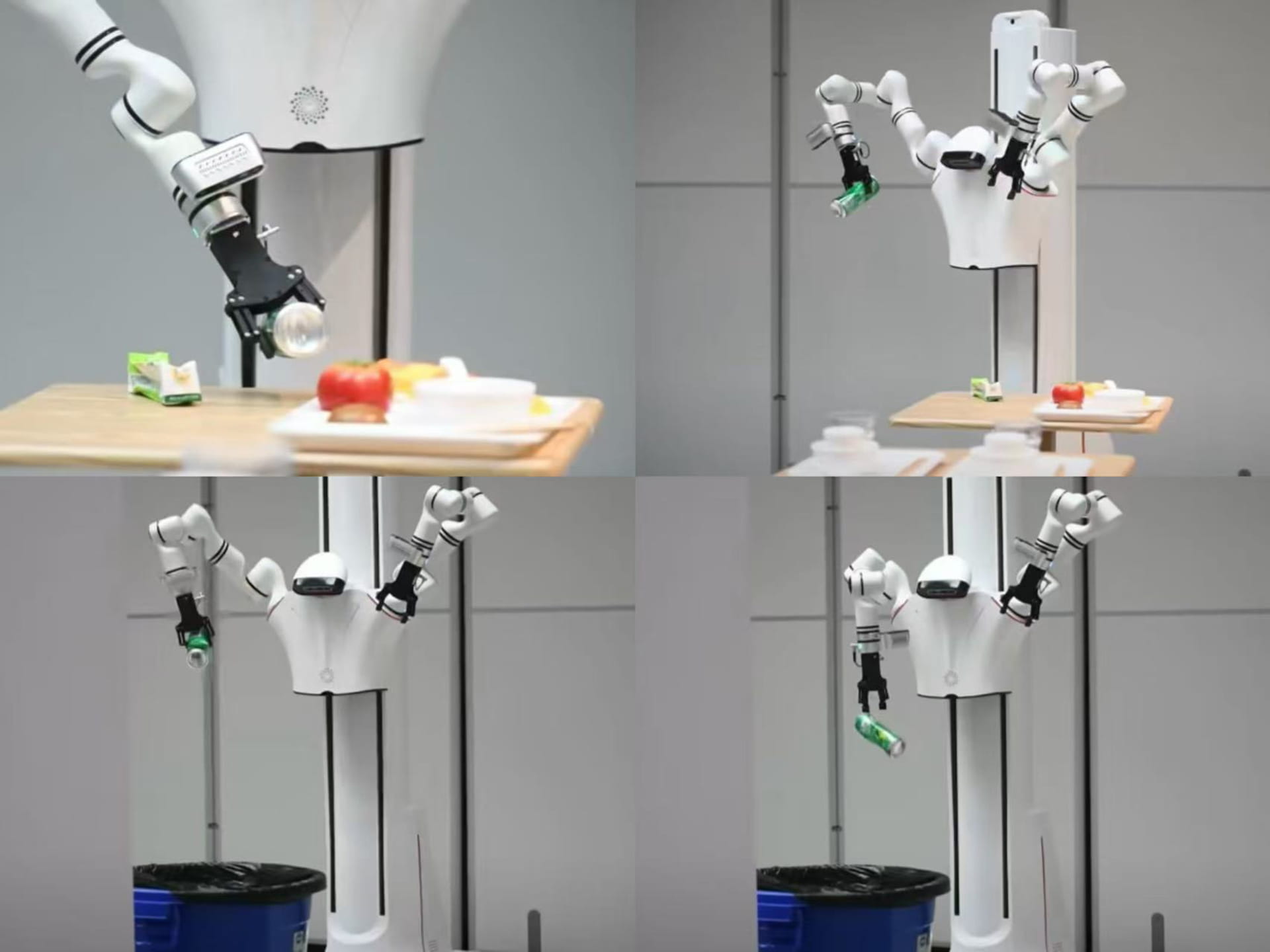
GH: The industry largely agrees that task planning and an understanding of how physical objects interact can transfer across robot bodies. Whether a four-legged robot uses a robotic arm or a humanoid uses its right hand, grasping a cup involves the same understanding of how the cup moves and how an external force changes its state. That answers “How will the cup be manipulated?” rather than “How should this particular body manipulate the cup?”
The latter involves controlling the body’s actuators and is closely tied to the hardware. Four-legged robots, drones, and humanoids have completely different motion-control requirements. That part cannot transfer directly.
The limits of a model that applies the same intelligence across different robot bodies are determined by the data it is built on. Even an advanced architecture will suffer a substantial decline in task success rates if it lacks data from the relevant distribution.
Qianjue wants to develop reusable capabilities in task understanding, environmental perception, and decision-making and planning, then combine and adjust them to suit each robot’s limits. That makes the capabilities more reusable while retaining the adaptations each execution system needs.
36Kr: Business customers may not care about the differences between VLA and world models. What do they actually need, and what should determine whether a deployment succeeds commercially?
GH: They want to know whether a robot allows them to hire one fewer person or reduces picking errors in a warehouse. Deploying embodied intelligence is about solving these small, specific problems.
For example, a robot we developed for hotels takes clothes out of a laundry basket and puts them into a washing machine. It sounds simple. But making it work reliably, without stalling or snagging clothes, across different fabrics and arrangements involves countless engineering details. Customers will not pay an extra cent because we use an advanced predictive world model. They care whether the job gets done well, how often the robot fails, and whether it is worth the price.
Or consider a robot that organizes a shoe cabinet, picks up crumpled paper, and finds a phone. In humanoid form, it might sell for RMB 200,000 (USD 29,800), but a user might value those capabilities at only RMB 3,000 (USD 446). That gap is a practical barrier to deployment. Our R&D can pursue the most exciting possibilities, but the product we bring to market has to be simplified into a form customers will pay for.
36Kr: What was the biggest change in your thinking when you moved from a Tsinghua research group to running a company? What did business teach you that academia had not?
GH: In a laboratory, the criteria are straightforward: algorithms, papers, and whether a technical approach works. You try to push the technology as far as possible. After starting a company, that entire system changes.
I have always felt that I have to consider commercial realities first, and technology second. Technology matters, but an entrepreneur is responsible for products, customers, and business results.
We have quite a few people with doctorates, but this is not an academic venture. We conduct foundational research and turn it into working systems. That research has to stay connected to real demand and be tested against the problems robots encounter in actual use.
In business, winning a customer for a real deployment is a victory. An algorithmic breakthrough alone is not. Even the best technology has no practical value if it cannot work in real applications and win customers’ acceptance.
Concepts change quickly in embodied intelligence, and investor enthusiasm creates plenty of noise. Managers have to distinguish valuable technical advances from stories manufactured by the market and stay on course instead of following every trend.
36Kr: Some robot hardware companies are preparing for potential stock market listings, and investors also expect independent listed businesses to emerge in intelligence, models, and data. Will the race to list affect Qianjue’s technical choices or resource allocation?
GH: The timing of a listing will not be our main consideration. Capital markets can provide funding, but a technology company’s lasting position depends on its technology, products, and deployment results.
The market often overstates the importance of an IPO window. An IPO does not secure a company’s place in the industry.
The central challenge in embodied intelligence today is commercial deployment, not a funding shortage. A listing can lend credibility to a brand, but its direct effect on winning new applications is limited. Listing would become decisive only after technical approaches converge and competition shifts primarily to capital. Right now, the challenge remains deployment.
Capital markets do assign different valuations to technical approaches based on listing expectations. But the sector is not short of money, and the marginal benefit of additional capital has fallen substantially.
Our strategy is to stay committed to our chosen technical direction while incorporating useful algorithms from other approaches. We will not let investor narratives dictate our choices.
36Kr: Investor enthusiasm is running ahead of commercialization, and many in the industry worry about a bubble. How do you view that anxiety?
GH: Fluctuations in enthusiasm reflect capital cycles more than company fundamentals. Looking at the industry today, you can find problems everywhere. Over time, many temporary difficulties will resolve themselves as the industry develops.
A company should neither expand blindly because capital is plentiful nor dismiss the industry’s long-term value when the market cools. The key is distinguishing what requires long-term commitment from what needs quick validation. You need to resolve issues quickly rather than get trapped in drawn-out efforts that consume resources.
Companies that expand on the back of a bubble are hit hard when capital retreats. By then, their businesses have too much momentum to change direction in time.
Qianjue did not follow that narrative from the start. Over the past few years, we have developed a habit of acting quickly and decisively. Whether funding conditions are hot or cold, we maintain our own pace. That is more than a strategic choice. It is a basic capability a company needs to keep operating.
36Kr: What unresolved obstacles do robotics companies still face?
GH: People are less impressed by exhibition demos now. Everyone wants systems that work in practice and improve through feedback, but several obstacles remain:
- First is data. Collecting it on physical robots is too expensive. Simulated data can help, but it cannot replace real interactions. Generalizing beyond familiar environments is even harder. Without the right data, even a good model can fail in a new setting.
- Second, there is no standard engineering solution for coordinating high-level intelligence with low-level motor control, or adapting systems across different robot bodies. We cannot expect one model to work across all hardware. Changing the robot’s form still involves substantial engineering costs.
- Third, technical approaches have not converged. Definitions of “world model” vary widely, and there is still a clear gap between demonstrations in research papers and commercial deployment.
- Fourth, technical ambitions often do not match commercial realities. A demo can show the upper limit of a system’s capabilities, but customers compare its value with its price. A powerful high-end prototype has to be simplified to reach an affordable price. Nontechnical factors, including market education and customers’ understanding of the product, can also slow adoption.
Finally, companies have to balance frontier R&D with commercial delivery. You cannot give paying customers technology that has not been adequately validated. Commercial versions have to be reliable. But a company cannot devote all its resources to short-term projects and abandon foundational research either. Every company has to keep working out how to allocate resources and separate its laboratory versions from the systems it delivers.
KrASIA features translated and adapted content that was originally published by 36Kr. This article was written by Huang Nan for 36Kr.
Note: RMB figures are converted to USD at rates of RMB 6.72 = USD 1 based on estimates as of September 17, 2026, unless otherwise stated. USD conversions are approximate and, where appropriate, rounded for ease of reference. They may not fully match prevailing exchange rates.