
What, exactly, should count as the “ChatGPT moment” for embodied intelligence?
At the World Robot Conference (WRC) on August 19, Wang He, founder and CTO of Galbot, posed that question to the audience at a forum hosted by the company.
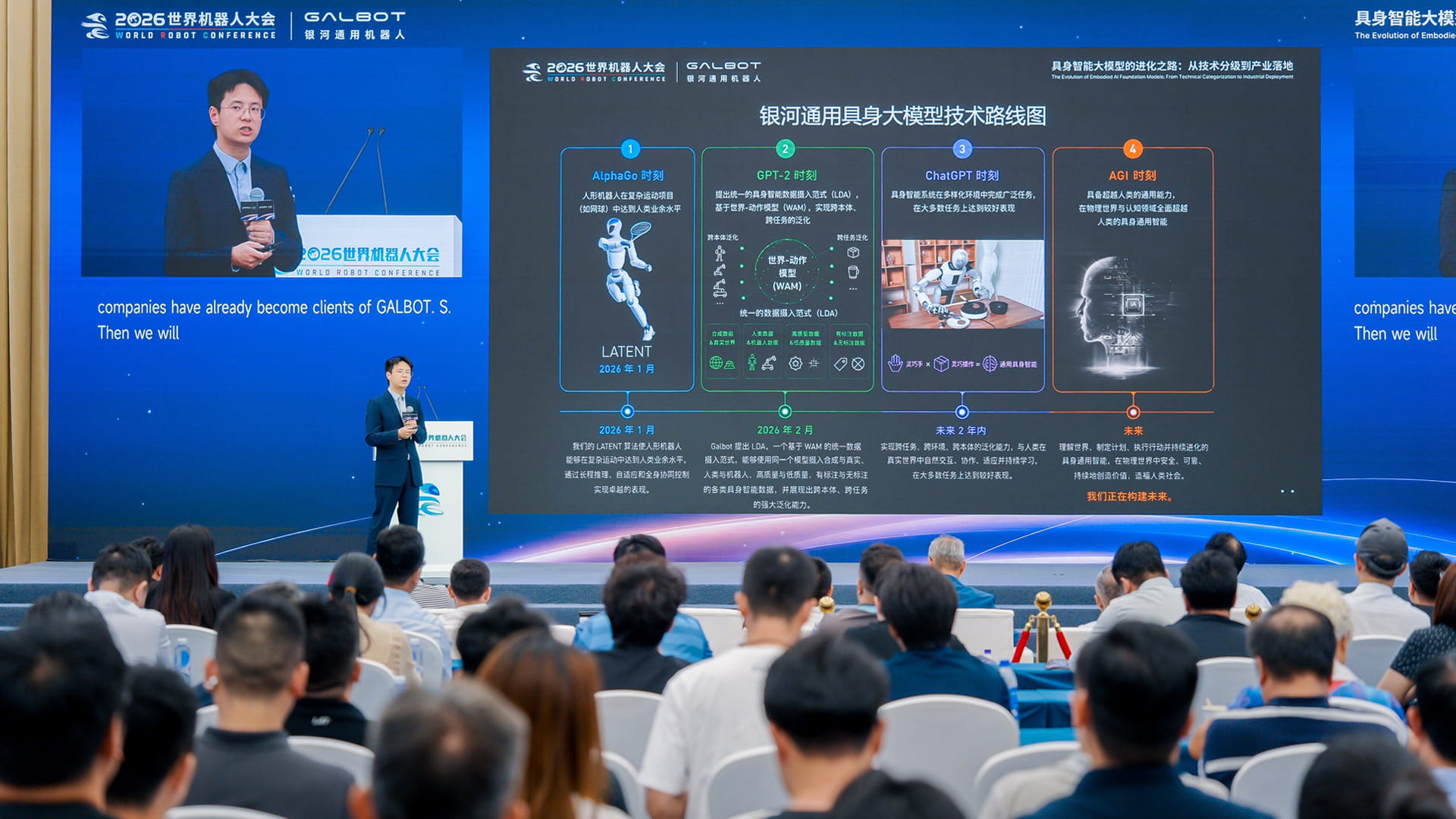
He has a demanding benchmark. Robots, he said, should be able to achieve zero-shot generalization on common skills they have never specifically learned, while ordinary users should be able to teach them new movements without any background in algorithms. To make that possible, humanoid robots need to understand the physical world, control their entire bodies and both hands, and continue learning over time.
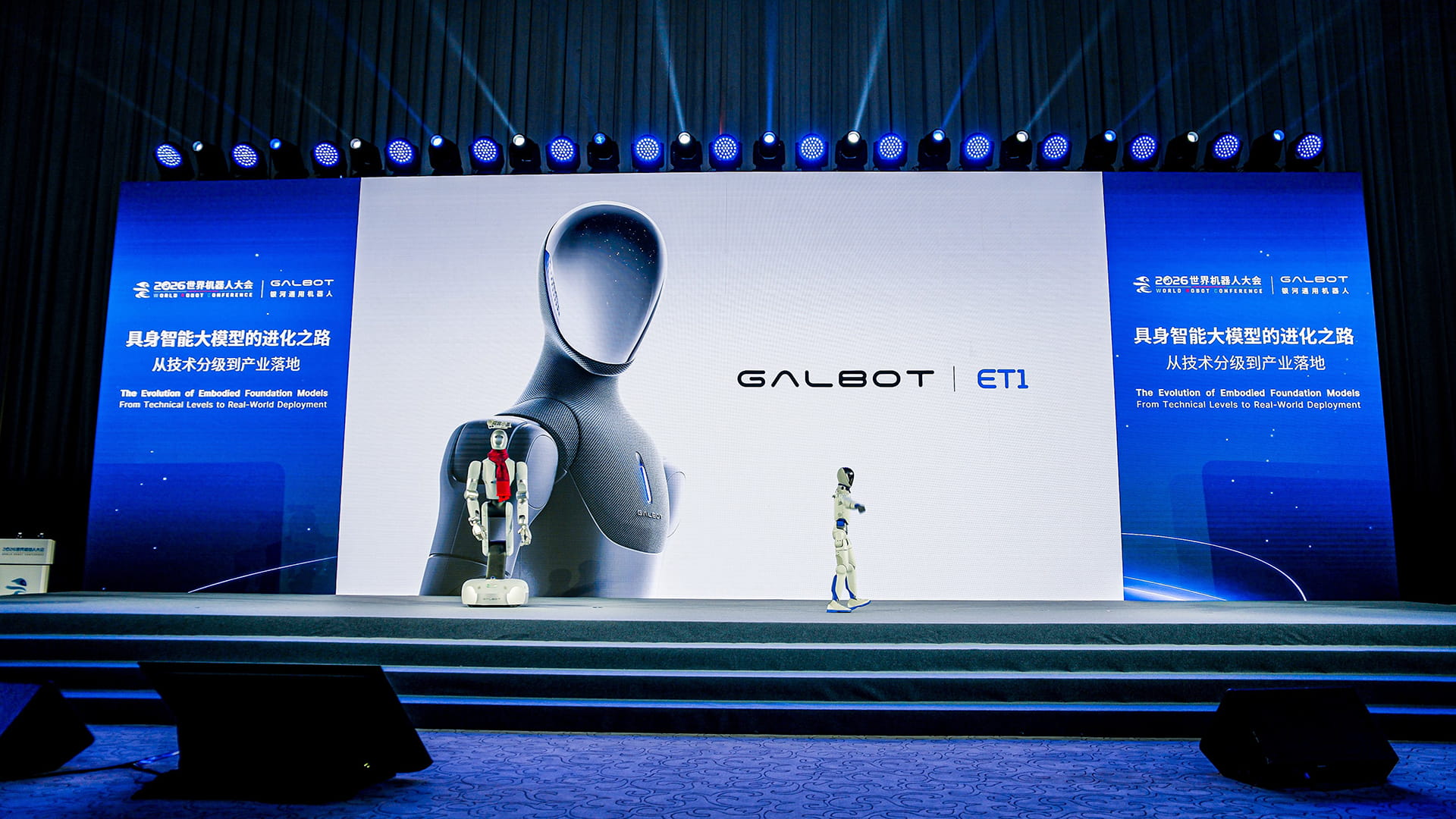
Galbot’s newly unveiled small humanoid robot, ET1, puts that idea into a new body. The company describes ET1 as the world’s first agent-based humanoid robot with autonomous learning capabilities. It runs on Galbot’s self-developed AstraBrain-Agent, which can observe its surroundings in real time, understand human instructions, and dynamically plan its behavior. Rather than preparing demonstration videos in advance, users can teach the robot new motor skills through interaction, according to Galbot.
Behind ET1 is the latest iteration of Galbot’s embodied foundation model, AstraBrain. While much of the humanoid robotics sector has focused attention on physical performance, Galbot has put embodied foundation models at the center of its approach.
Hardware may determine how a robot can move, but it is the model that increasingly determines what the robot can understand, learn, and do.
When agents enter the physical world
ET1 represents a different approach to building a humanoid robot.
Over the past two years, agents have become an established concept in artificial intelligence. In the digital world, they can call tools across software applications, find information, and carry out online tasks for users.
Physical AI agents operate under a different set of constraints. Their environments change continuously. A shift in an object’s shape, lighting, or position requires the model to understand what happened and then drive the body to respond.
Galbot said AstraBrain-Agent is designed around that feedback loop. Its perception and planning operate directly on physical space, and the result of its reasoning must ultimately be translated into movement. Once the robot acts, its surroundings change, creating new information that affects the next decision.
ET1’s interactive learning is built around this process.
In demonstrations, the robot identified the motion trajectory of a human dancer in real time and followed the person through hip-hop movements. It also maintained its balance while attempting more difficult movements involving floor support and handstands.
Supporting that movement is AstraBrain-WBC, Galbot’s general-purpose “cerebellum” model.
The model has been trained on more than 100,000 hours of human motion data, according to Galbot. Some of that comes from high-precision motion capture, while another portion is converted from human movement videos found online. The model uses that data to learn how people maintain balance, coordinate joints, and execute continuous movements, then transfers those motor patterns to robots without requiring engineers to program an entire trajectory in advance.
The approach reflects a broader shift in embodied AI development.
Traditionally, adding a new skill to a robot could require a team to collect new data and retrain the system. The resulting skill might also remain tied to a particular robot body or use case. AstraBrain-Agent is designed instead to preserve capabilities the model has already acquired while adapting to new tasks through limited additional interaction.
Galbot has organized AstraBrain around a “brain,” a bridge module, and a “cerebellum.” The brain understands the environment and plans actions. The cerebellum controls the full body and both hands. The bridge translates high-level intent into specific movements.
The brain uses a world action model (WAM) architecture, which Galbot said it was the first to propose. A vision-language-action (VLA) model can generate actions based on visual and language inputs, while a world model predicts how an environment is likely to change. WAM combines both capabilities in a unified model, allowing a robot to anticipate the physical consequences of an action and decide what to do next.
A central aim of AstraBrain WAM is to bring cross-embodiment, cross-scenario, and multitask capabilities into a single foundation model.
Galbot said the same model can control a G1 robot equipped with dexterous hands to pick products from supermarket shelves and perform tasks involving deformable objects, such as folding clothes. When transferred to a different robot body, it can also be used for new tasks.
The goal is to make accumulated model capabilities less dependent on a specific piece of hardware or operating scenario.
ET1 also uses AstraBrain-WBC to translate the intentions generated by AstraBrain-Agent into stable, continuous movement. According to Galbot, the model can generalize to some movements that were not included in its training data.
Tennis offers a demanding test of that ability. A robot has little time to respond: it must estimate the trajectory of the incoming ball, adjust its position, strike, and maintain its balance.
ET1 uses Galbot’s LATENT framework for high-dynamic tennis planning and control. In demonstrations, the robot adjusted its movements in response to shots from a human opponent and sustained rallies.
Putting the model to a real-world test
At Galbot’s WRC booth, AstraBrain was also demonstrated across a range of everyday tasks.
One involved an apparently mundane breakfast routine. The robot had to complete a sequence that included picking up bread, pouring water, and arranging items on a plate.
The more revealing moments came when the sequence was disrupted. A spectator might remove a cup, for example, or an object the robot was targeting might suddenly be blocked from view.
In the demonstration, the robot replanned based on the changed environment and continued with the remaining steps.
Conventional industrial robots typically work best when processes and environments remain tightly controlled. The physical world is less predictable. A person reaching across a table or moving a cup can change what a robot should do in the next second.
Folding clothes presents another problem.
Unlike rigid objects, clothing has no fixed shape. Each time a robot grasps a garment, the folds change. The model must reassess the garment’s state, identify an appropriate grasping point, and update its plan after each manipulation.
For industrial use, however, succeeding once in a demonstration is not enough. What matters is whether a robot can repeat a task reliably at high volume. Accuracy, operating stability, and the ability to handle exceptions ultimately determine whether a deployment is economically useful.
Galbot has been testing those questions in commercial environments. The company said its robots have been deployed in smart pharmacies and on-demand retail settings, where they identify products, pick them from shelves, and hand them to delivery riders.
Those actions may be repeated many times each day, turning reliability and exception handling into operating requirements rather than demonstration metrics.
Industrial tasks pose a different set of constraints.
Galbot said its S1 robot has two arms and can handle payloads of up to 50 kilograms, allowing it to move heavy materials. As payloads increase, the robot has to adjust its posture and force while tracking nearby people to support safe human-robot collaboration.
These scenarios vary substantially. One involves soft clothing that constantly changes shape. Another involves densely packed retail shelves. A third involves heavy industrial materials.
Galbot’s aim is to use AstraBrain as the common technical foundation across them.
That also turns deployment into a source of training data.
Smart pharmacies, on-demand retail environments, and industrial production lines generate problems that can be difficult to reproduce in simulation, including changes in packaging, equipment drift over long periods of operation, and unpredictable interference from people.
That information can be fed back into training, after which updated capabilities can be deployed to robots again.
At the forum, Galbot said it would open its simulation platform, data collection hardware, embodied foundation models, and reinforcement learning post-training pipeline to technology companies and industry partners. It also plans to allow developers to create new movements and applications for ET1.
The strategy is intended to broaden the range of physical-world problems available to the model. More users and deployments can generate more varied data, which can then be used to improve subsequent versions.
Embodied models become a new dividing line
Over the past few years, much of the attention around humanoid robotics has focused on the body.
Unitree Robotics has been one of the clearest examples. Its shares rose as much as 629% during their August 19 trading debut in Shanghai before closing 460% above the IPO price, reflecting strong investor demand for one of China’s best-known humanoid robot makers.
How fast a robot can run, how high it can jump, and how much impact it can withstand are highly visible measures of engineering progress. But once robots enter pharmacies, supermarkets, and factories, movement alone is not enough.
A robot must interpret instructions, handle unfamiliar objects, and respond when people or objects unexpectedly move around it.
The body determines where a robot can go. The model increasingly determines what it can do.
That is making embodied foundation models another important point of differentiation within the industry.
Hardware performance can be measured relatively directly. General-purpose intelligence is harder to build and benchmark. Models need exposure to a wide range of tasks and physical interactions, then must be tested repeatedly in real environments.
The broader that experience becomes, the more prior knowledge a model can potentially draw on when it encounters a new task.
Galbot identified data infrastructure as a central part of that problem early in its development.
Its AstraData system organizes training data into a five-layer pyramid. Internet data helps the model understand semantics. Human motion data provides examples of physical actions. Simulation platforms generate training samples at scale. Real-robot teleoperation data helps calibrate fine-grained movements. Finally, data gathered from robots operating in real environments feeds problems encountered in deployment back into the training system.
At the forum, Wang said Galbot had accumulated one million hours of human data and 80,000 hours of real-world feedback data.
The team began building an egocentric human-object interaction dataset in 2021, according to Wang. Today, Galbot has connected its data collection hardware, simulation platform, and model evaluation system to the same infrastructure.
The cycle is self-reinforcing. More deployments expose AstraBrain to a wider range of real-world situations. Better models can, in turn, reduce the effort needed to adapt robots to new tasks and embodiments.
Deployment and model development can therefore reinforce each other, creating what Galbot describes as a data flywheel.
That brings the discussion back to the original question: when will embodied intelligence have its ChatGPT moment?
Wang proposed two benchmarks:
- Robots should be able to achieve zero-shot generalization on common skills that people themselves do not need specialized training to learn, with success rates of 70–80%.
- Ordinary users should be able to carry out post-training at low cost, allowing robots to adapt quickly to their own working environments.
The second condition may prove just as important as the first.
Even when a model can perform much of a task, customers may still need algorithm engineers to collect robot motion data, label it, and debug the resulting behavior. That adaptation cost can make deployment difficult for smaller businesses and individual users.
For embodied intelligence to reach a mass market, teaching a robot also has to become substantially easier.
During his presentation, Wang introduced WAM-TTT, a test-time training approach intended to address that problem.
Under the approach, a user wears a first-person camera and records themselves doing a job. The model can use that unlabeled video to adapt to the task without requiring a fresh round of robot motion data collection, according to Galbot.
The foundation model supplies general knowledge about the physical world. A person demonstrates the specific work to be done.
If that process becomes reliable, adapting a robot could begin to look less like an engineering project and more like teaching a new worker.
At the end of his presentation, Wang outlined a longer-term vision in which robots could eventually approach smartphone-scale shipment volumes while retaining product values closer to automobiles and the continuous upgradeability of software.
A model improvement could then be distributed across a large installed base of robots.
The scale of that opportunity remains hypothetical, but the underlying problem is already clear.
Humanity spent decades generating the language, images, and other data that now train models for the digital world. Comparable training data for the physical world is far less abundant.
Robots will have to help generate it themselves by identifying products in pharmacies, responding to disruptions in factories, manipulating unfamiliar objects, and learning jobs from human demonstrations.
Each deployment can become another source of experience for the model.
The ChatGPT moment for embodied intelligence, by Wang’s definition, will arrive only when that accumulated intelligence can transfer across different robot bodies and when teaching a robot a new skill becomes simple enough for ordinary people to do.
KrASIA features translated and adapted content that was originally published by 36Kr. This article was written by Xiao Xi for 36Kr.