
Chinese retailer Miniso is betting its next phase of overseas growth on a portfolio of proprietary IP, backed by plans to open 100 stores in the US this year.
The company has signed 30 artists globally, including those from Japan, South Korea, and Thailand, prioritizing original characters rather than licensed external brands for future growth, Miniso CMO Robin Liu told Nikkei Asia. About a third of those artists have had their characters turned into merchandise that is now on sale.
The New York Stock Exchange-listed company has been collaborating with brands like Disney’s Marvel, Peanuts, and Japan’s Sanrio since 2019 to produce lifestyle and apparel products using its network of suppliers. Miniso now wants to build character branding it owns outright.
“We need the capability to incubate and operate these IPs, create higher commercial value,” Liu said in an interview. “This also ensures our product offering is unique.”
The Chinese brand, which opened its first store in Guangzhou in 2013, operates thousands of discount variety shops selling goods that range from stationery and toys to cosmetics and clothing.
Its first original character, “Yoyo,” launched in June last year and within six months garnered RMB 100 million (USD 14.7 million) in sales, primarily in China. Liu expects the character to generate roughly RMB 800 million (USD 117.8 million) in revenue this year.
Liu said the company visited Netflix and Sony Pictures to explore the possibilities of turning Miniso’s characters into a film or other content.
“We might engage in deeper collaborations in the future, but I think it will be a gradual process,” he added.
To introduce Miniso’s characters to the US market and raise its brand awareness, the company launched an exhibition at New York’s Grand Central Station, featuring 50 Yoyo character sculptures last month. It opened a similar gallery in Shanghai’s Bund City Hall Plaza in May.
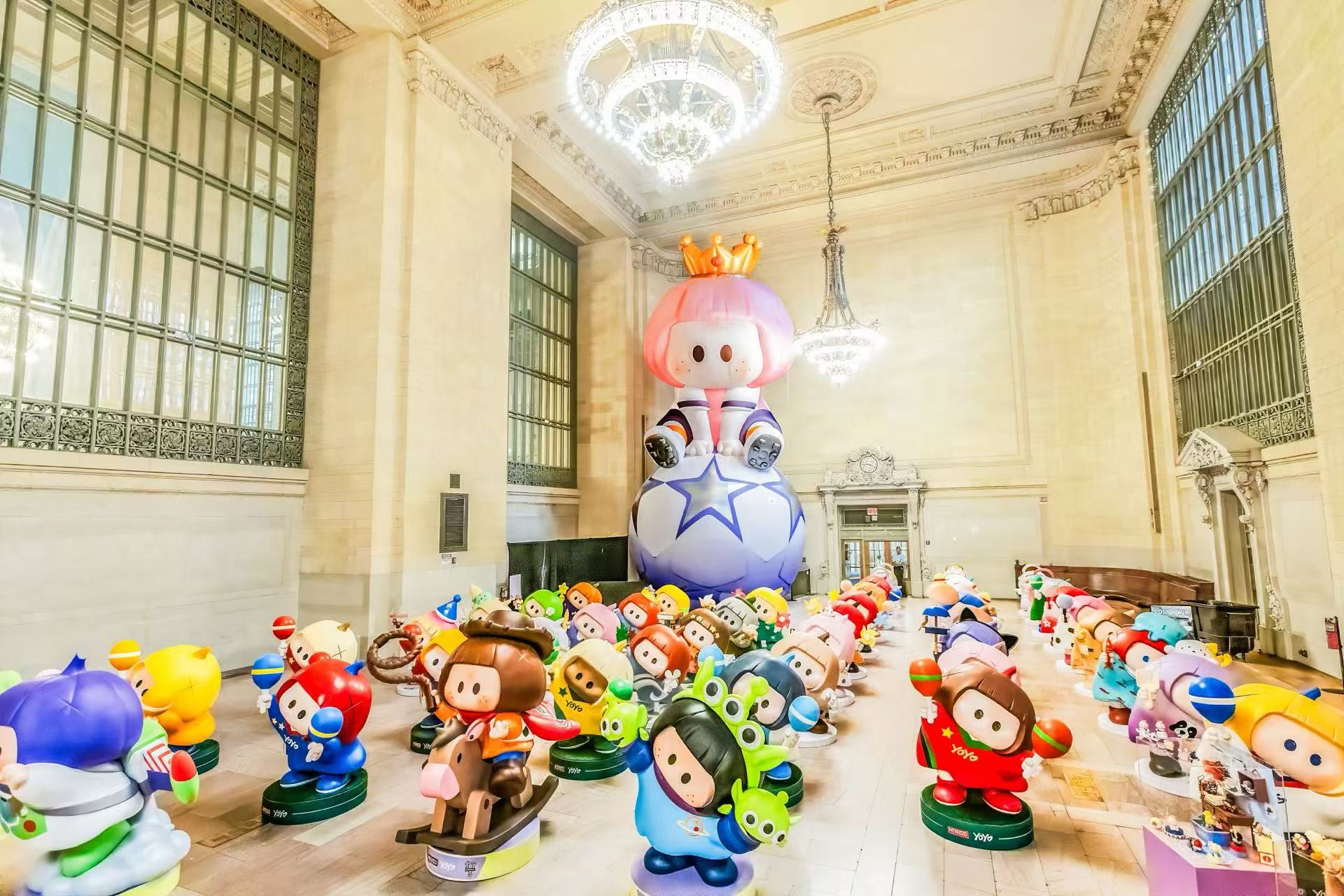
The company will use “immersive retail” to showcase the growing portfolio of characters, a concept that has boosted sales in China, according to Tom Bartlebaugh, CEO of Miniso USA.
Miniso plans to open the first three experiential stores in Las Vegas, Columbus, Ohio, and East Rutherford, New Jersey, featuring interactive attractions such as claw machines. Existing US stores will also be remodeled.
Miniso, which entered the US in 2017, now has 380 stores and plans to expand its footprint by 20%. Building brand recognition in the US remains a challenge, Bartlebaugh said. The company will increasingly target strip malls and larger street-front locations rather than traditional shopping malls.
The US is the top priority because it is the company’s largest revenue market outside of China, Liu said.
The focus also reflects a tougher retail environment in China, where a consumer spending slowdown remains subdued after a yearslong property slump. Despite that, the company has continued to grow domestically and believes its expanding roster of characters will help drive further growth.
Miniso’s shift toward a character-based portfolio doubles up with its subsidiary brand Top Toy, which sells blind boxes with figurines and plush toys, analysts noted.
Liu said the two brands will complement each other and can share marketing resources. But Top Toy is focused on being designer art toys, it is more professional and high end than Miniso’s mass market appeal, he added.
Loo Wee Teck, global insight manager for toys and games at Euromonitor International, said there is demand for licensed toys but customers are drawn to well-known franchises.
He added many characters are released into the market, but few actually become as widespread as Chinese toymaker Pop Mart’s Labubu.
“Miniso can compete in distribution and price, but building a character with lasting global resonance is a much harder challenge,” said Loo.
Lina Yan, HSBC’s consumer analyst, said it took Pop Mart nearly two decades to scale one of their other characters to revenue levels of RMB 3 billion (USD 441.9 million) last year.
“Miniso could still grow meaningfully in this segment if it can successfully build and compound a dedicated fan base—rather than simply selling in-house IP toys to its existing customers by substituting for other product categories,” she said.
Liu said Miniso views Pop Mart as the industry’s benchmark and is studying its approach to developing IP. Together, Miniso and Top Toy aim to sign on and manage 100 artists by year’s end.
“The market can’t be dominated by just one company like Pop Mart,” Liu said.
This article first appeared on Nikkei Asia. It has been republished here as part of 36Kr’s ongoing partnership with Nikkei.
Note: RMB figures are converted to USD at rates of RMB 6.79 = USD 1 based on estimates as of July 14, 2026, unless otherwise stated. USD conversions are presented for ease of reference and may not fully match prevailing exchange rates.