
Robotics has become one of the businesses Xpeng CEO He Xiaopeng most needs to focus on in the second half of the year.
On June 5, Shi Xiaoxin, the top product executive at Xpeng’s robotics business, resigned. Five days later, He sent an internal letter to all employees, announcing that he would personally serve as CEO of the robotics business, just as the unit appeared to be nearing mass production and commercialization.
Part of the pressure comes from targets Xpeng has already made public. In May, He held a robotics mass production mobilization meeting with more than 1,000 attendees alongside Vice President Gu Jie and robotics center head Mi Liangchuan. In addition to setting a clear target of achieving mass production of humanoid robots by the end of 2026, He emphasized Xpeng’s position as the only company in China with full-stack in-house R&D across chips, operating systems, joints, dexterous hands, and other components.
For the team, that also means a level of difficulty and pressure higher than that of many peers.
He moved quickly. On June 26, 21st Century Business Herald reported on Xpeng’s new organizational structure for its robotics center, which includes nine secondary departments. Gu Jie, Liu Xianming, and Yu Tao were appointed as the three department heads. The vacancy left by Shi’s departure from the product department will be filled personally by He, who began his career as a product manager.
But Mi’s name disappeared from the internal letter and the organizational reshuffle. An internal source told 36Kr that Mi began considering leaving after Shi submitted his resignation. “He is effectively close to resigning without another job lined up,” the person said. 36Kr contacted Xpeng’s public relations team for comment but had not received a response by publication time. 21st Century Business Herald later published an exclusive report on Mi’s departure.
The signs of a leadership change at Xpeng’s robotics center have become increasingly clear. Multiple headhunters told 36Kr that Zheng Cunyuan, another leader at Xpeng’s robotics unit whose importance was said to be on par with Shi’s and who oversaw the complete robot body, had quietly left as early as late May 2025 to start his own company. Before the Iron robot drew attention with its November 2025 debut, when its high degree of realism led some viewers to suspect there was a person hidden inside, Mi, Shi, and Zheng formed a trio that led Xpeng’s robotics team.
So who will be the new person in charge?
“He Xiaopeng may not have fully thought it through yet,” a person familiar with the matter told 36Kr. After Shi tendered his resignation, He met with a leading figure in smart driving. The two sides did not discuss recruitment, but He’s motivation for the meeting may have included wanting to test whether he could once again recruit a key leadership figure from another field.
“We really do not want to see another cross-industry leader who did not originally work in robotics,” one frontline employee told 36Kr. Looking back at Mi’s previous role and contributions to the team, the employee said Xpeng should view the appointment as a personnel experiment that did not work as intended.
Ambiguity and hesitation in senior hiring decisions have long filtered down into Xpeng’s recruitment process for robotics, and this time is no exception. “At first, for senior roles, they were open to people from other fields. For a period, they shifted toward preferring people who had directly worked in robotics. Recently, they became open to cross-industry candidates again,” one headhunter said, sounding puzzled. “Xpeng is not exactly a company that can attract talent with high salaries.”
Several headhunters who have helped Xpeng recruit people said their impression is that the HR contacts responsible for the business tend to leave or be replaced every few months. “Maybe just as the person has built up industry know-how, they get replaced,” one of them said.
To understand the pressure Xpeng is facing, the technical dimension might not be the first place to look.
“What actual output did Mi Liangchuan personally deliver?” one industry insider asked when discussing Mi’s previous value and positioning within Xpeng’s robotics business.
In past public appearances and some media reports, Mi was the public face of the unit. He had the credentials: a former Nvidia executive, an alumnus of the University of Science and Technology of China, and a researcher at Carnegie Mellon University. He joined Xpeng in 2021 as senior director of autonomous driving and took over the robotics business unit in September 2023. He later became chair of Xpeng’s AI technical committee and was promoted to company vice president. On paper, he spanned both Xpeng’s automotive and robotics businesses.
“Mi Liangchuan is a typical ‘reporting-oriented executive’ who barely participates in substantive business,” a former employee said. A human resource professional who had worked with Mi said he was very good at managing upward, understood CEO He extremely well, and knew how to communicate with him. “He basically had the instruction manual for He Xiaopeng,” the person said.
In 2023, during the period when Xpeng’s robotics business was transformed from an independent company into a group-level business unit, Mi helped rebuild the organization’s culture. His cross-business background also played a role in coordinating internal resources between the robotics and automotive businesses.
The problem is that while managing upward can help a new business secure internal resources and time, it can also create a risk during the mass production phase: an execution vacuum in middle management. “The worst thing is when the boss thinks everything is fine, but the frontline knows nothing has actually been implemented.”
“There is bound to be a gap when someone with an automotive background crosses over to lead a robotics business,” an HR professional at another robotics company told 36Kr, summarizing what she had observed in recruitment over the past six months. In her view, Mi’s biggest issue as the main leader of the robotics business at a prominent company was that he “did not understand robotics deeply enough.” “It was not that there was a problem with his basic ability. He may simply not have been put in the right position.”
According to his public resume, after earning his undergraduate degree, Mi studied for a master’s degree in robotics at Iowa State University. He also worked as an electrical engineer at Carnegie Mellon University’s Robotics Institute, participating in the development of obstacle avoidance systems for medical service robots and laser navigation solutions for drones.
“To be fair, Mi is not a completely ‘nominal’ leader. His educational background appears to be close to robotics, so there was a possibility that he could lead across fields. But his later hands-on experience in formal roles fits more of an artificial intelligence-native profile, including Nvidia, autonomous driving, and deep learning, rather than the embodied-native profile that investors currently favor, which involves a systematic understanding of hardware supply chains, mechanical structures, motion control, and manufacturing yield.”
An earlier article introducing Mi said he applied know-how from his automotive and data experience to robotics. The awkward part of that claim is that automotive thinking emphasizes process, standards, and zero tolerance for errors. Robotics mass production, at its current stage, requires rapid iteration, tolerance for trial and error, and flexible adjustment. It has not yet reached a stage where automotive-grade standards can lock things in.
The practical requirement is clear: on the eve of mass production, the best leader for a robotics business is someone who can take a team from the lab to the production line, watch manufacturing yield on the factory floor, and negotiate directly with suppliers. Looking back at Xpeng Tech Day at the end of 2025, when Mi explained onstage how Iron achieved a humanoid gait, he said: “This is an inflection point for our generative controller, but I cannot say exactly which optimization brought about the change. I can only say that when data and computing power reached a certain level, the leap happened.”
“The number one leader should ideally understand the field directly. The people doing the work below can come from other industries, but if you want to firmly hold a senior business role over a team with an engineering background, your professional ability needs to command respect internally. You need deep accumulation in vertical expertise and to have invested significant energy and time in understanding the technology,” one person familiar with the business said.
Perhaps because He previously crossed over from the internet sector to build cars, he has placed more hope in cross-industry hiring.
The trio
Still, under the coordinated leadership of Shi Xiaoxin and Zheng Cunyuan, two leaders who had been almost invisible in front of the media, along with Mi, Xpeng managed to unveil its new-generation Iron robot at the end of 2025 as scheduled.
“Administratively, Shi Xiaoxin was one level above Zheng Cunyuan. Both reported to Mi Liangchuan,” one person said. In this structure, Mi was responsible for reporting upward and external-facing work, Shi focused on product, and Zheng oversaw complete robot technology.
As a veteran who had been with the team since its Pengxing Intelligence days, former senior product planning director Shi was one of the few people on the team who had handled both technology and productization. He and Zheng went through the transition from Pengxing Intelligence together and also survived the turbulence of layoffs, when only a few dozen people from the old Pengxing team were retained. “In the key leader roles, only the two of them were left,” one person said.
According to 36Kr, Shi is low-key, meticulous, and attentive to balance. “[He Xiaopeng] valued him a lot. Had he not chosen to leave, he could absolutely have stayed at Xpeng until retirement,” one team member said with regret. “Even things like going to the factory to choose materials and steel grating were handled by him. His shortcoming was that he did not know how to report upward.”
Zheng’s departure was as low-key as Shi’s. According to public information, Zheng earned a master’s degree in mechanical engineering from Columbia University. As an undergraduate, he founded Harmony SHR, which worked on exoskeletons. He interned at SpaceX and, during his master’s studies, worked as a researcher at GE Research in the US. Before joining Xpeng, he was head of industrial robot R&D and chief product officer at Topstar Technology in China.
On Maimai, Zheng’s career history has not been updated and still ends at Xpeng.
“Tyler’s WeChat Moments cover photo is still Iron. When the debut happened last year, he even posted a Moments update congratulating his former employer,” one person said. Before leaving the team, he completed overall system integration work for the newest generation of Iron at the time. “Tyler has a more distinct personality. He speaks directly and can sometimes seem like he is bluffing, but he gets real work done.”
Around May 2026, a co-founder with the alias “Zheng Tianle” appeared at Kinetix AI’s launch event and in its press releases. 36Kr cross-checked the information and confirmed that “Zheng Tianle” and “Tyler” likely refer to Zheng Cunyuan.
How did three people with different personalities coordinate while working together?
“They each drew on their own strengths and made up for one another’s weaknesses. Together, they held up Xpeng’s robotics business for two years,” a former employee said. The person said the three had highly similar thinking about the first principles of robotics and the future direction of the business, and did not have major differences over key business decisions.
“They put great emphasis on first principles: build the hardware first, incubate algorithms at the same time, and accumulate intelligence.” In terms of aggressiveness, He himself once publicly said Mi was even more “aggressive” than he was about building robots, and that Mi believed he was trying to “build a human,” not merely “build a robot.”
Mass production creates the split
The mass production target created disagreements.
According to people familiar with the matter, in the early days when the trio worked well together, “they could set their own targets, and He Xiaopeng gave them a lot of patience.” But before the new-generation Iron was released, after mass production targets were proposed internally, He began offering more macro-level strategic guidance, and the parties could no longer reach the same level of consensus.
He’s position is not difficult to understand.
First, software and hardware development cannot remain in lab mode indefinitely. Product maturity ultimately comes from delivery.
Second, without scale, the cultivation of the industrial chain will remain at the level of hundreds or dozens of units and struggle to reach automotive-grade or commercial-grade quantities.
Third, as a listed company, Xpeng needs to align with external expectations and respond to investor pressure.
Mass production itself is not the problem. The key is how to mass produce.
Every company’s robots are still undergoing rapid iteration at this stage. If the initial mass production volume is set too high and the product’s performance fails to meet market expectations, neither the company nor the broader industry can be sure it will be able to absorb the consequences. How to control scale is the core issue.
One view that once came from inside the company was that “the focus of assessment should be defining what capabilities were achieved behind the numbers, whether mass production delivery standards and good long-term relationships have been formed with high-quality suppliers, and whether the stability of software-hardware integration is approaching product-stage readiness as closely as possible, rather than staring at a shipment figure of 10,000 units.”
The disagreement reflects a clash between two product methodologies. Xpeng’s revenue in 2025 reached RMB 76.7 billion (USD 11.3 billion). In automotive-grade and consumer-grade thinking, revenue below a certain scale has limited meaning. But robotics is different. Unitree Robotics delivered more than 5,500 humanoid robots in 2025, with each unit priced between RMB 99,000–650,000 (USD 14,537–95,445.1). Its overall revenue from the humanoid robotics business was only several hundred million RMB. Compared with automotive and consumer businesses, that revenue gap is more than one order of magnitude.
The leadership structure would eventually complete its historical role. Organizational management and operating methods are shaped by scale and by the need for a new talent matrix. The arrival of more senior experts also means the roles of original senior figures can be compressed, while their room to maneuver can narrow.
In July 2025, two months after Zheng left, former Tencent technical expert Ge Yixiao and Chen Jie, former head of reinforcement learning at ByteDance’s Seed team, joined Xpeng to lead multimodal work and reinforcement learning at its robotics unit, respectively. According to people familiar with the matter, both have deep expertise in intelligence, but their concrete results after joining Xpeng remain to be seen.
Hiring hesitation
No matter how much patience He may have given the robotics business before, it has now reached a point where he has no choice but to go all in, according to 36Kr, which cited a recent internal letter.
Several industry insiders told 36Kr that Xpeng has been searching since last year for embodied intelligence experts in product, motion control, and other areas. But due to salary, business direction, scarcity of relevant talent, and other issues, it has not yet found suitable senior candidates.
As a result, the HR personnel responsible for the robotics segment have changed frequently. As noted earlier, each HR person has had little room for trial and error, making it difficult to build and reuse a solid understanding of the robotics business and the related talent market. At the same time, Xpeng has wavered in defining the profile of the talent it needs. Initially, Xpeng’s criteria did not prioritize whether candidates had a robotics background, and it paid considerable attention to talent from consumer hardware fields such as DJI. Later, robotics backgrounds came back into favor. Now, the criteria appear to have changed again.
Looking at the industry as a whole, the talent market in 2026 includes three types of people: academic talent, cross-industry talent, and embodied-native talent. The first group has a strong theoretical foundation but still needs to grow in engineering implementation, real-machine deployment, and understanding of mass production. The second group is more readily available and can get started quickly, but depending on each person’s origin and background, still needs a period of exploration.
The concept of embodied nativity was first proposed by Dexmal, a startup from the Megvii system, in February. It argues that the development of embodied intelligence should build AI systems from the outset on interaction with the physical world as the fundamental starting point, rather than adapting general-purpose large models to robots.
Through industry conversations, 36Kr found that embodied nativity has become one of the more compelling narratives in the industry in 2026. At the macro level, embodied-native companies place greater emphasis on viewing robot development from an overall systems perspective, including motion control and hardware composition, and reverse-engineering each step from the final goal and deployment scenario. This is markedly different from the traditional strategy adopted by companies such as Anker Innovations, which proceeds step by step from modules to the whole, from local parts to the complete machine, and gradually opens up the hardware supply chain.
From the perspective of capital validation, venture capital investors generally believe that the robots that will truly enter homes in the future will come from teams with complete systems.
At the talent level, compared with macro narratives, some headhunters have begun discussing more specific concepts such as embodied-native talent and robot-native talent. The more common term AI-native talent refers to compound talent whose thinking, workflow, and system design are built around AI as the underlying core.
The same framework applies here.
Embodied-native talent refers to people whose thinking, workflow, and system design are built around the closed loop of interaction between AI and the physical world. Algorithms, sensors, actuators, and scenario data are not separate modules in their cognitive system, but different syntax within the same native language.
Robot-native talent, by contrast, places greater emphasis on traditional electromechanical control and the hardware body as the underlying architecture, with AI capabilities grafted on later as an add-on.
Although the two are often used interchangeably in headhunter conversations, strictly speaking, the former corresponds to the embodied-native paradigm, while the latter points more toward the AI transformation of the previous generation of robotics engineers.
Zhao Tongyang, the main leader during the Pengxing Intelligence period, was a typical robot-native talent. In 2020, He and his team met Zhao, founder of Dogotix, at a factory in Shenzhen, and the three parties later formed Pengxing Intelligence as a joint venture. Zhao was the most discussed leader during the Pengxing period. Together with He, he went through the difficulties of Xpeng’s quadruped robotic horse project, compromises over the technical route for humanoid robots, and disagreements over team size and management methods. After winning the turnaround battle for the Xpeng P5, he suddenly chose to leave.
In September 2023, Xpeng spent USD 98.96 million to fully acquire Pengxing Intelligence. Zhao gave up his equity in exchange for freedom from noncompete restrictions, left, and founded EngineAI. Mi was the person parachuted into the robotics business from autonomous driving at that time, serving as vice president as the independent company was transformed into a business unit.
RELATED ARTICLE
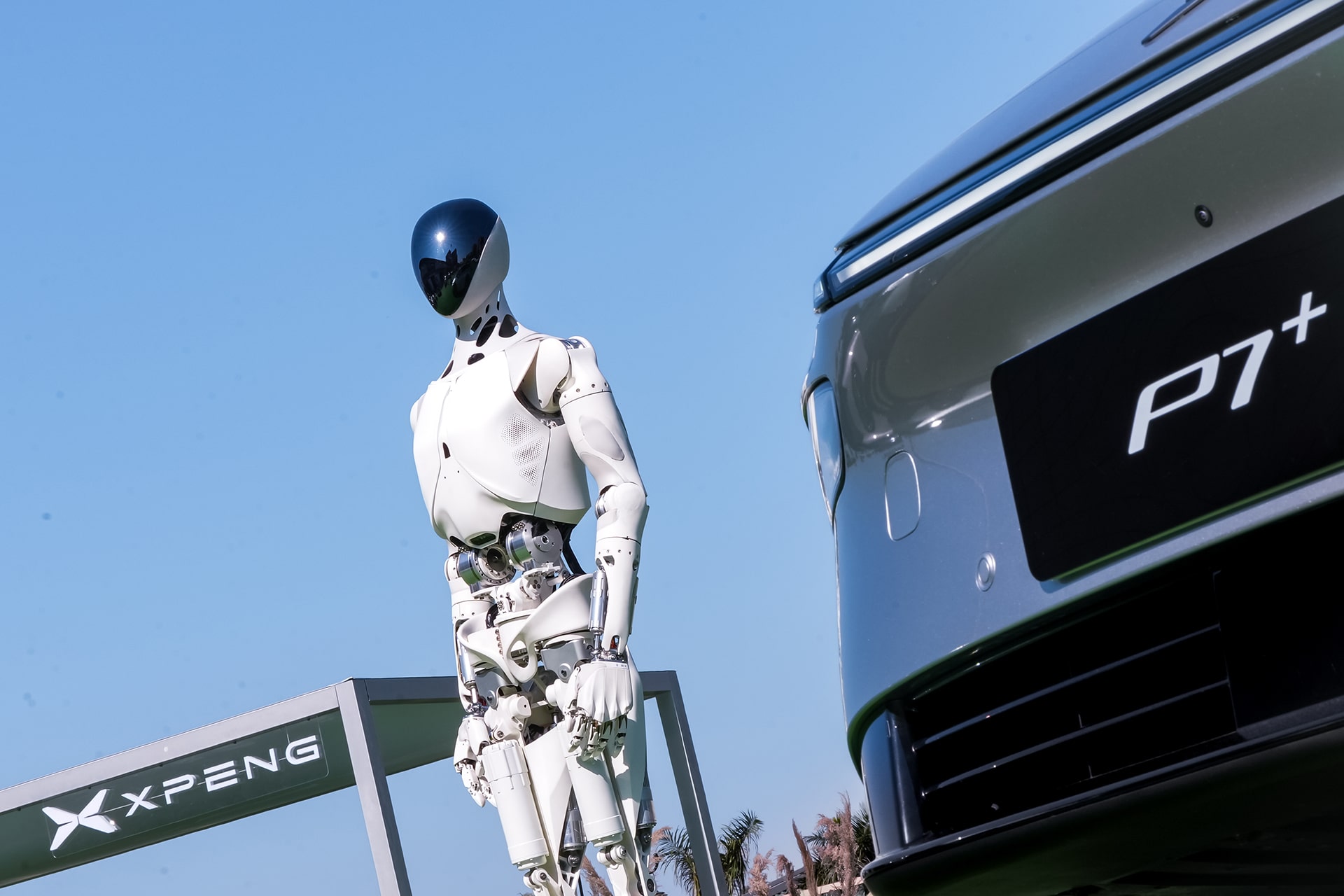
Still, Xpeng has its own distinctive positioning. Compared with robot-native companies such as Unitree Robotics and Agibot, automakers have a natural advantage in data feedback. Xpeng does not need to rely on users or third-party companies. It can build its own data collection system and database through an automaker’s physical industrial scenarios.
Xpeng’s rivals also include other automakers moving across industries.
According to Stella Li, BYD executive vice president, BYD’s self-developed humanoid robot has been developed in secret for four years, and the in-house development rate for core components exceeds 80%. However, BYD has denied online rumors that it would internally deploy 20,000 units in 2026.
Li Auto has completed an organizational restructuring, setting up three major departments: embodied engineering, embodied interaction, and embodied behavior.
Nio continues to refine its world model.
Chery’s Mornine has completed batch delivery of 220 units, making Chery the first automaker in the world to achieve batch deployment of humanoid robots.
For now, Xpeng clearly feels pressure, but it still has certain advantages compared with these cross-industry companies. Amid the wave of automakers moving into embodied intelligence, most companies’ robotics businesses take the form of a business unit or subsidiary, led by a vice president or general manager. He Xiaopeng personally serving as CEO of the robotics business is unusual among mainstream automakers.
“Xpeng’s automotive team has been eyeing the robotics team for a long time, wanting to absorb it,” a former employee quipped when asked to assess the new organizational structure. In any case, after the departure of the key trio, He has not, at least for now, chosen to give up or scale back.
What kind of people will Xpeng bring in next? Will there be a new leader for its robotics business? With less than half a year left, He has compared Iron’s current stage to the eve of the launch of Xpeng’s first car, the G3, eight years ago. For him, that moment was not an easy memory. After the G3, Xpeng went through production capacity and quality crises, as well as organizational turmoil. He himself also transformed from chairman into CEO.
If greater challenges follow mass production, Xpeng will need capable lieutenants alongside him to face them.
KrASIA features translated and adapted content that was originally published by 36Kr. This article was written by Fang Tingyu for 36Kr.
Note: RMB figures are converted to USD at rates of RMB 6.81 = USD 1 based on estimates as of July 9, 2026, unless otherwise stated. USD conversions are presented for ease of reference and may not fully match prevailing exchange rates.