
Chen Bo, co-founder of the company behind the Elegoo brand, has become a different person.
Three years ago, if you met him, you would have found him flamboyant, bordering on cocky. Chen had absolute confidence in the company’s products and capabilities. Competitors were seen as having “nothing special” about them.
Three years later, he told us this: some things are worth trying with everything you have, but if the company still cannot deliver the results it wants after several years, then someone more capable should take over the business, even if that means bringing in a professional manager.
In the venture capital world, where founder worship remains deeply entrenched, that is a jarring stance. It is also one that did not emerge in isolation.
According to 36Kr, the company has completed a Series B+ funding round worth a nine-figure RMB sum. The round was backed jointly by Meituan’s DragonBall Capital, Shenzhen Capital Group, Hillhouse Investment, Yintai Group, Panorama Capital, Mornway Capital, and Shenzhen HTI Group. This deal comes less than six months after a previous round that included DJI.
For much of the past decade, people have been fascinated by, and chased after, savant-like founders, treating them almost like religious figures. They do not need to be eloquent, or even likable, but they must have an overpowering personality and some extraordinary gift. Even if they are domineering, autocratic, or cold, they are still revered by countless followers.
From Silicon Valley to China, from Steve Jobs and Elon Musk to Sam Altman, this trend has not faded. Over time, this class of founders has shown that it can build standout companies.
But the company behind the Elegoo brand does not belong in that category. It began in Huaqiangbei, a scrappy, grassroots business environment common in Shenzhen. Its headquarters are in Longhua, where factories are ubiquitous. Its founders prefer doing business to talking about changing the world. Chen has never romanticized entrepreneurship.
Within the founding team, there is a pragmatic entrepreneurial instinct common in Guangdong: adapt continuously to changes in time, market, region, and culture. The team is flexible and grounded. When it realizes it cannot achieve its goals, it is willing to acknowledge limitations and pivot quickly.
This shift is evident even in the company’s approach to outside capital. For years, the three co-founders refused external investment and declined media interviews. Quietly making money has long been a defining trait of bosses in Chaoshan.
During that period, they invested heavily in R&D and even abandoned one product line. Yet they found the gap between their products and those of competitors continued to widen. “That was the moment I realized that our efforts could no longer keep pace with the intensity of the market,” Chen said.
His conclusion was direct:
“If the three of us cannot do it, then that means there is something wrong with our own capabilities. […] If I cannot lead them forward, then I should step aside for someone better.”
They took the initiative to find an intermediary and approach DJI. Within three months, they had secured a financing deal. Chen, who once avoided public exposure, also began speaking to the media.
As co-founders, Hong Yingsheng and Chen remain ambitious. They believe the 3D printing market has significant room to grow and is far from reaching maturity. The company must remain competitive, capture growth opportunities, and potentially become a market leader. To achieve that, the founding team is willing to relinquish some control, along with pride and emotion. As Chen put it:
“Business is not a game of make-believe.”
36Kr spoke with Chen about the company’s experience over the past three years and its plans for the future.
The following transcript has been edited and consolidated for brevity and clarity.
36Kr: You did not really want to appear in public or speak out before.
Chen Bo (CB): A company’s cultural style is really set by its founders. Why didn’t we speak publicly very often before? Because our founders are not that kind of outwardly lively personality. Even as recently as two years ago, we did not want the media to know anything about us, not even a few words.
That has something to do with Chaoshan culture. He is from Chaoshan, and I am Hakka, but our personalities are really the same. What we admire is the Pony Ma style: keep your head down, make money quietly, and get rich quietly.
36Kr: Why choose to speak up now?
CB: At the most basic level, it is what growth now requires. What I am seeing is that the world has already entered a new cycle. In the past, we talked about cross-border e-commerce expansion. Now we talk about brand globalization. This is the phase when Chinese brands are directly challenging legacy global brands such as Sony and Apple. Who will become the global brands of the future?
Aside from the top deep tech companies, there is still room for change among smaller and midsize companies like us during this process. So we can no longer stay small-minded and boxed into our own circle.
36Kr: What do you think is Elegoo’s biggest weakness right now?
CB: Our weakness right now is software. But we need to be clear: this is not the kind of internet software built for mass customer acquisition, scale effects, or a closed-loop business model. It is software that must be tightly integrated with hardware. It includes two layers. One is the machine’s own firmware and slicer software, which drive the hardware. The other is ecosystem software that works alongside the machine, such as model libraries and mobile apps.
So even though we are only referencing hardware, what it really refers to is the ability to build a closed-loop 3D printing ecosystem in which software and hardware are integrated with one another. At the moment, only a few companies really have that capability. Bambu Lab is clearly the best at it. We are still not good enough.
RELATED ARTICLE

36Kr: People used to think 3D printing was mainly about hardware specs. After Bambu Lab entered the market, where exactly does its software advantage show up? Is it in printing efficiency or simply in polish?
CB: Bambu Lab’s entry raised the bar to where it is today. If you break the industry down, its hardware is not necessarily the best, but its software really is a moat. For the rest of the industry, including us, it is very difficult to catch up in a short period of time.
What software really solves is stability. Before Bambu Lab came along, most of the industry’s software was only at the level of “just usable.” It played a supporting role, while hardware was where most of the innovation happened. But if you look at what came next, even with fairly ordinary hardware, as long as the software is tuned well enough, the user experience can still feel very smooth.
36Kr: What is the most intuitive difference in that “stability” from the user’s perspective?
CB: At the core, it is the success rate, both for a single print and for continuous printing.
Put simply, if a home user buys from a second-tier 3D printer brand, the machine may need to be reset and releveled every half month or so before it can keep working. In the past, that did not seem like a major issue, because at least users no longer had to calibrate it manually. But Bambu Lab machines can remain stable for more than a month.
That is the difference in consistency. It is not a hardware issue, because a hardware reset can restore precision. It is a software control issue. After each print, can the system remember the precision drift produced by the hardware? Can it restore accuracy every time? That is what algorithmic accumulation gives you. We are still working hard to catch up there.
36Kr: So that is why you now want to use DJI’s methodology?
CB: We really are learning DJI’s product development methodology. Its software and algorithms are what we need. Another thing we need is DJI’s firmware development methodology for integrating software with hardware. But rather than copying what its firmware looks like, it is about understanding the system behind it.
Across the industry, including at Bambu Lab, you see the same problem: the hardware product gets built, but software tuning cannot keep up. If you can bring in that methodology, it helps correct the trial-and-error process that kept making us stumble before.
36Kr: Has Elegoo thought about attempting it in-house?
CB: We did try to build a team and do it ourselves. A few years ago, we hired a group of people to try to break through. Did it produce results? Definitely, yes. But it was basically all trial and error, and very inefficient. We found that hardware can be accumulated and iterated step by step.
People have already grasped the pattern there. But software is a zero-to-one problem. Our previous team lacked software thinking. Even if you build a team, it takes time for that team to grow, and your rivals are improving too. So now we are changing course and improving the way we do this.
36Kr: If you bring in this system and, after testing it, still cannot build a good product, would you make even more drastic adjustments?
CB: Our position is very clear: reform ourselves. If the products we build in 2024 and 2025 still cannot meet the market’s expectations or compete head-on with rival products, then that means our management capability has hit its ceiling.
Our attitude is open. If we cannot do it well, then someone more suitable should do it. We would even consider bringing in a professional manager. Frankly, if the three of us cannot do it, then that means there is something wrong with our own capabilities. I take the same view with the departments I manage. If I cannot lead them forward, then I should step aside for someone better.
36Kr: If the cooperation becomes that deep, or even turns into a kind of takeover, how do you preserve your own control?
CB: The logic is the same: if you end the cooperation, do you have another way out? No. Your profit margin may fall, but in terms of total profit, if you used to make RMB 100 million (USD 14.6 million) and in the future you can make RMB 3–5 billion (USD 439.1–731.9 million), why would that not be acceptable? Business is not a game of make-believe.
We started in Huaqiangbei. This is a Shenzhen-style, grassroots form of entrepreneurship. Later, we transitioned from a cross-border e-commerce model into product development. At the time, there was an opportunity, and the sector had a very high ceiling, so we pursued it. But if, after all our efforts, it still does not work, then of course we have to adjust.
Let me put it this way: if I give you RMB 200,000, (USD 29,276.6) you can go buy a pretty good car and drive it immediately. But if you take that RMB 200,000 and try to develop a car yourself, you may not even be able to make a wheel in the end. So which option is more cost-effective? When you cannot do it yourself, you need the decisiveness to choose differently. As long as you can stay at the table, that is better than getting pushed out.
36Kr: When we met in 2023, you still seemed full of swagger.
CB: I started changing around late 2024 to early 2025. In theory, by the end of 2024, we should have launched a product to capture the next wave of growth. At that time, some rivals had already gone two years without launching a new product, and we wanted to beat them to it.
But the product developed by the team we assembled in 2023 kept getting delayed. That was the moment I realized that our efforts could no longer keep pace with the intensity of the market. It was agonizing, because we were already in an all-in mindset. Every resource had been assigned to developing that product, and yet the result we delivered still could not keep up with products our competitors had already launched.
36Kr: Have you not gone through that kind of setback before? Did it make you doubt yourself?
CB: Things had gone relatively smoothly before, but self-doubt was never the issue. We have been entrepreneurs for a decade.
What we did immediately was look for a way forward. We went back and analyzed the success patterns of those top performers and found a very interesting phenomenon: in the field of consumer hardware going global, the core teams behind top brands such as Bambu Lab, Insta360, and EcoFlow largely came out of DJI. That means DJI does not just produce products. It also exports a system-level hardware engineering capability that the market has validated over and over again.
That shared DNA made us realize that DJI was the technical “mothership” that could help us break through our bottleneck. Once we saw that the best available answer was right in front of us, we went straight to DJI. That was the path we were looking for.
At the time, once a familiar intermediary introduced us, things moved very quickly. From the first conversation to confirming the partnership, the process took very little time.
36Kr: So what was the main cause of the delay?
CB: It still came down to our ability to engineer for mass production. You may have done a lot of advance work on many technologies, but when you try to put them all together into a single machine, a bug in one part can affect the whole system.
At the time, the clearest issue was that multicolor efficiency did not meet the required standard. In the end, we were forced to launch only a single-color version overseas. And in China, I did not sell that generation at all. You can imagine how painful that was.
36Kr: Some of Elegoo’s crowdfunding campaigns did pretty well over the years.
CB: One of our products shipped more than 200,000 units overseas last year. From an industry perspective, that is already a strong result. But if you are standing in front of the top player, then you are nothing. Even if you rank second in terms of single-model sales, if the market leader sold one million units, then 200,000 means a fivefold gap.
And with that kind of gap, what is the point of being second? What is the difference between second, third, or fourth? What is the difference between those and fifth or tenth? There is none. Switching places like that is meaningless.
So yes, you did build something. But when outsiders look at you, you still do not carry enough weight.
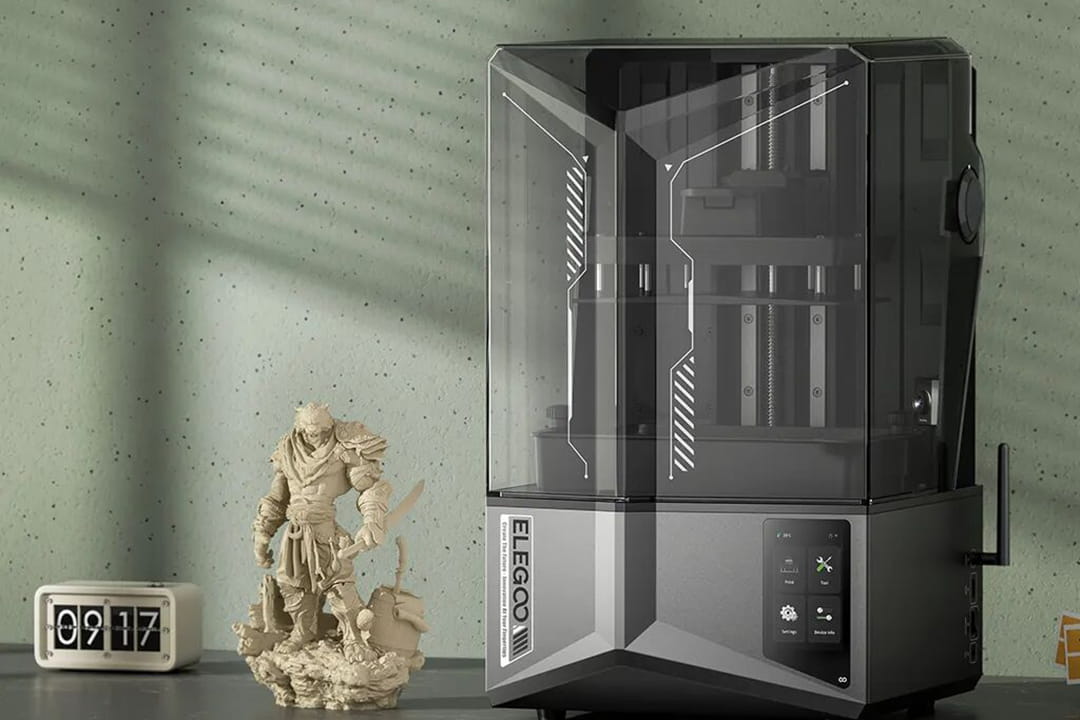
36Kr: Elegoo’s revenue is still growing over these three years, but it no longer seems to be doubling at the pace it once was.
CB: If you look at it on an annualized basis, we have actually maintained a growth rate of 30–50%. It is just that after Bambu Lab entered the market, its absolute growth and growth rate outpaced ours to such an extent that our own growth no longer seemed worth mentioning.
When the gap first opened up a little, say I was at RMB 1 billion (USD 146.4 million) and my rival was at RMB 2.5 billion (USD 366 million), I could still tell myself that with twice the effort, maybe I could catch up. But three years later, it is at RMB 10 billion (USD 1.5 billion) and I am at RMB 2.3 billion (USD 336.7 million). That means the effort I made before was not enough. You put in the work, but not the results.
36Kr: What is the target, then?
CB: This year, our goal is RMB 3.5–4.0 billion (USD 512.3–585.5 million). In the future, our gap with Bambu Lab cannot stay at five times. At most, it should be one to two times.
36Kr: Some investors may think there is nothing wrong with backing the player in second place, like Pepsi versus Coca-Cola. From their perspective, where does the value of Elegoo lie as an asset?
CB: Investor attitudes toward us do follow that logic to some extent. The leader may already be impossible to invest in, or its valuation may be too high, making the price-to-performance ratio less attractive. In that case, the company managing the Elegoo brand becomes a good asset.
At the very least, the founding team is still seriously doing the work, and the market is still paying for its products. If, later on, a few technologies fall into place and become a moat, then we can capture the incremental market.
That is also how we explain it internally. It is not about surpassing the leader in the next two or three years. Our focus is on whether we can stay at the table until the settlement phase.
And before that phase arrives, there are several markers to watch. The earliest one is who goes public first.
36Kr: But outsiders may worry that the gap could become fixed or even widen further.
CB: If you view it as a sprint, then yes, that is true. But I believe this industry still has at least ten years of long-term growth ahead. In a mature market, the leader may take most of the profit. But right now, there is still incremental demand, and capital can continue to push you forward.
Also, this industry’s level of technical integration is not as high as people imagine. Today’s machines still face a significant usability barrier compared with household appliances. They are not products you can use effortlessly right away. In that process, is the leader the only one that can solve those problems? No, it is not.
36Kr: So Elegoo’s goal is to make the product truly compatible with at-home scenarios?
CB: Everyone wants to build something ready for the home. Everyone is pushing cheaper, smaller product lines. Right now, I treat DJI as a “teacher” and try to learn from it directly. What I am betting on is that within a few years, we can inherit that technology and engineering capability.
Right now, 3D printers are still somewhat large, clunky, and crude. As things stand, the gap overseas is still significant, while the Chinese market still depends on whether its potential can truly be unlocked. The overseas market grew out of DIY culture. Users there are more tolerant, and they see tinkering with the machine itself as part of the fun.
36Kr: It feels as if the product definition logic in China and overseas is completely different. Does the domestic market need a fundamental change in form?
CB: Yes. If you think in terms of scoring, overseas consumers will pay for an 80-point product. In China, you need to hit 95 or above. Ninety may only be a passing grade, and 95 is what counts as excellent. If you are below 90, Chinese users will complain about you everywhere.
China places more emphasis on practicality. What is the cost of buying this? How long will it take to recover that cost? Even individual users may think: if I buy this for my child and the child likes it, can it also help with a maker project and improve school admission prospects? Overseas, there is less of that utilitarian thinking. The main question there is what kind of enjoyment the machine can provide.
36Kr: Is a fivefold gap something that can be closed over the medium to long term?
CB: Hoping a competitor makes a mistake is not the way a boss should think. Our judgment is that technologies go through development curves and eventually converge, just like smartphones. In the end, the hardware gap among players will narrow. At that point, what matters even more is everything beyond hardware, such as marketing costs and the supply chain.
That is an area where we are confident. Hardware performance will converge.
Especially now that we have additional support, product form will become much closer. After that, it is mainly a matter of time and accumulation.
36Kr: Elegoo’s path to survival sounds completely different from that of the market leader.
CB: Everyone has a different way of surviving. We are not a new company. We began overseas online e-commerce and offline distribution in 2015. We have strong control over brand and pricing because all of our online channels are operated directly by us.
Many competitors came out of trading. They first sold goods to distributors, and their control over the brand was weaker. We are different. My distributors are allowed to operate only offline, not online. That limits their options, but it allows me to control the brand across the entire market.
36Kr: That sounds a bit like the logic used by some smartphone makers.
CB: That is also one of the reasons investors recognize us. I may not be able to make a 100-point product, but I can sell that product very well.
In our view, in the Chinese market, 90 points may only be a pass, and 95 is what counts as excellent.
36Kr: Elegoo has always stressed its cost advantage. How is your thinking on cost different from traditional approaches?
CB: Our cost advantage does not come from cutting corners. It comes from industrial methods and engineering quantification. We aim to push nascent production technologies in the industry toward lower costs through scale.
Industrial collaboration is crucial. Hong Yingsheng, the founder and CEO, has deep experience. We often joke that if you hand any electronic product to him, he can estimate the bill of materials within 30 minutes. It is hard to get past his scrutiny.
For example, with cross-industry parts integration, some components are only auxiliary materials in larger industries, with limited volume. But if we integrate them and turn them into primary materials for our own use, then volume increases significantly and the scale advantage emerges. You need to know a large number of suppliers to do that.
36Kr: In supply chain management, corruption and cost control are always difficult problems.
CB: The power of institutional systems is far greater than most people imagine. What matters is what kind of system you have and whether it can screen out those problems.
We are extremely strict on cost control, and we monitor it continuously. If someone tells me the logistics price difference exceeds RMB 0.3 (USD 0.044), that person will not need to come to work the next day. A difference of RMB 0.3, multiplied by several thousand tons of cargo a month, means a gap of several million RMB. Finance is not afraid of differences of RMB 100,000 (USD 14,638.3) or RMB 1 million (USD 146,382.9). It is afraid of a difference of RMB 0.01 (USD 0.001). The advantage accumulated from these tiny line items is the hardest to detect.
36Kr: With a transformation of this scale, do conflicts emerge internally over resource allocation and culture?
CB: Of course. We believe product performance will remain central for a long time, so resources must tilt toward R&D. Our operations team is in the Shenzhen North Station area, while our technical team is in Shenzhen Bay, where office conditions are better. That is one kind of compromise in organizational layout, and it also shows where the center of gravity lies.
36Kr: Back in 2023, when Bambu Lab was just taking off, your attitude toward it seemed quite different. Why such a big shift?
CB: My attitude has actually been consistent. At the time of that interview, our resin printing business was still our core, while FDM (fused deposition modeling) was a new competitive area for us, and our foundation there was relatively weak. Now the gap still exists, but we have moved closer.
The difference is that we have now entered the artificial intelligence era. AI is advancing rapidly, so whether all the content we accumulated before still counts as a positive asset is now also a question.
36Kr: Do you think AI could wipe out previously accumulated value?
CB: Yes. In the past, 3D printing content depended on individual designers, who created for all users to consume. Since ordinary users did not have the ability to produce 3D models, everyone focused on building model libraries and competing on quantity and quality, spending heavily in the process. That was essentially an internet-style strategy of heavy investment.
Looking back now, after AI entered the scene, those past investments may effectively be reset. AI-generated content will rapidly reshape existing model libraries. So now everyone is making a two-track bet: maintaining content libraries while also investing in AI-generated model production.
36Kr: What is the main bottleneck in training a large model specifically for 3D right now?
CB: Training is genuinely difficult, and talent is extremely hard to find. Large companies have built strong barriers, making it difficult for us to recruit from them. We want to build a team for training a 3D large model, but we cannot attract the most suitable AI talent from top companies.
To be honest, we cannot afford them, and at this stage, our competitors probably cannot either. Those core teams receive annual compensation packages above RMB 10 million, along with several times that amount in equity or options. It is very difficult to compete with that.
On the computing side, all we can do is purchase from major platform companies. There is no way for us to build that infrastructure ourselves, and there is little difference in pricing across buyers. At this stage, the only thing we can do is focus on our own strategy and determine the right time to enter.
KrASIA features translated and adapted content that was originally published by 36Kr. This article was written by Leslie Zhang for 36Kr.
Note: RMB figures are converted to USD at rates of RMB 6.83 = USD 1 based on estimates as of April 21, 2026, unless otherwise stated. USD conversions are presented for ease of reference and may not fully match prevailing exchange rates.