
At a Bangkok noodle restaurant made famous by Michelin, delivery drivers arrive one after another to pick up bags of soup and noodles before riding off on their motorcycles.
A common sight in front of the Rung Rueang eatery is riders in green jackets with the Line Man logo. The homegrown delivery operator has gained market share over the years, creating a locally rooted ecosystem that is now expanding beyond its core food delivery service.
“We are transforming our company from a food delivery operator to an AI-driven tech startup with more on-demand services,” CEO Yod Chinsupakul told Nikkei Asia in an interview. Yod also said the company is shooting for an IPO and “the deadline is 2027.” With the funds, he added, “we will invest in technology, particularly in AI.”
Line Man, a consolidated subsidiary of Japan’s LY, the operator of the Line messaging app, has about ten million active monthly users, a seventh of Thailand’s population. It also has 700,000 restaurants on its nationwide roster.
According to research by Singaporean consultancy Momentum Works, Line Man in 2025 held a 41% share of Thailand’s food delivery market as measured by gross merchandise value (GMV). This put it in second place behind Singapore-based Grab, which controlled 47%, and was more than double the 20% share the brand held in 2020, with rivals like Foodpanda retreating and eventually withdrawing from the market.
Since its establishment in 2016 under Line’s Thai unit, Line Man has grown through several mergers and acquisitions and funding rounds.
In 2020, Line Man merged with Wongnai, a Thai restaurant review site, adding Wongnai’s network of eateries to its delivery platform; at the same time, it raised USD 110 million in Series A funding. In a Series B round in 2022, the platform received USD 265 million and became a unicorn—an unlisted company valued at more than USD 1 billion.
Last year, Line Man acquired local startup Jera Cloud, which provides online booking management for beauty clinics, wellness centers and spas, marking its expansion beyond its core food business and bringing Jera’s more than 1,700 business partners to its platform.
Meanwhile, the company has integrated related services such as Line Pay to strengthen its ecosystem. It also provides point-of-sale software to merchants, which Yod said has helped it build strong relationships with restaurants.
Early this year, it brought telepharmacy, which lets users consult with pharmacists, to the Line Man app, where patients can also arrange medicine deliveries.
“I think there’ll be a couple of other new services that will launch this year,” Yod said. He also said Line Man has hired more than 50 AI engineers to develop additional features.

Regarding the venue for the IPO, Yod mentioned Hong Kong, Singapore, and Nasdaq in the US as candidates for the venue, though he did not exclude the local option, the Stock Exchange of Thailand. The company will finalize its plan by the third quarter of 2026, he said.
Yod declined to provide further details on how much capital it is looking to raise from the IPO. However, he said that the funds would be used to fight price competition, invest in artificial intelligence and other technologies, and make acquisitions.
“AI helps a lot in terms of sales capabilities,” he said. “That’s something that will be a big improvement in terms of managing merchants’ accounts, helping them grow (and) introducing new tools to them.”
He said the company will soon introduce an “AI helper” to enable restaurants to create photos and menus and write product descriptions.
An LY spokesperson told Nikkei Asia that an IPO would accelerate Line Man’s growth by tapping capital markets and help the Tokyo-listed parent increase its shareholder value. When asked if the parent would sell part of its Line Man stake, the representative said, “Nothing has been decided at this point.”
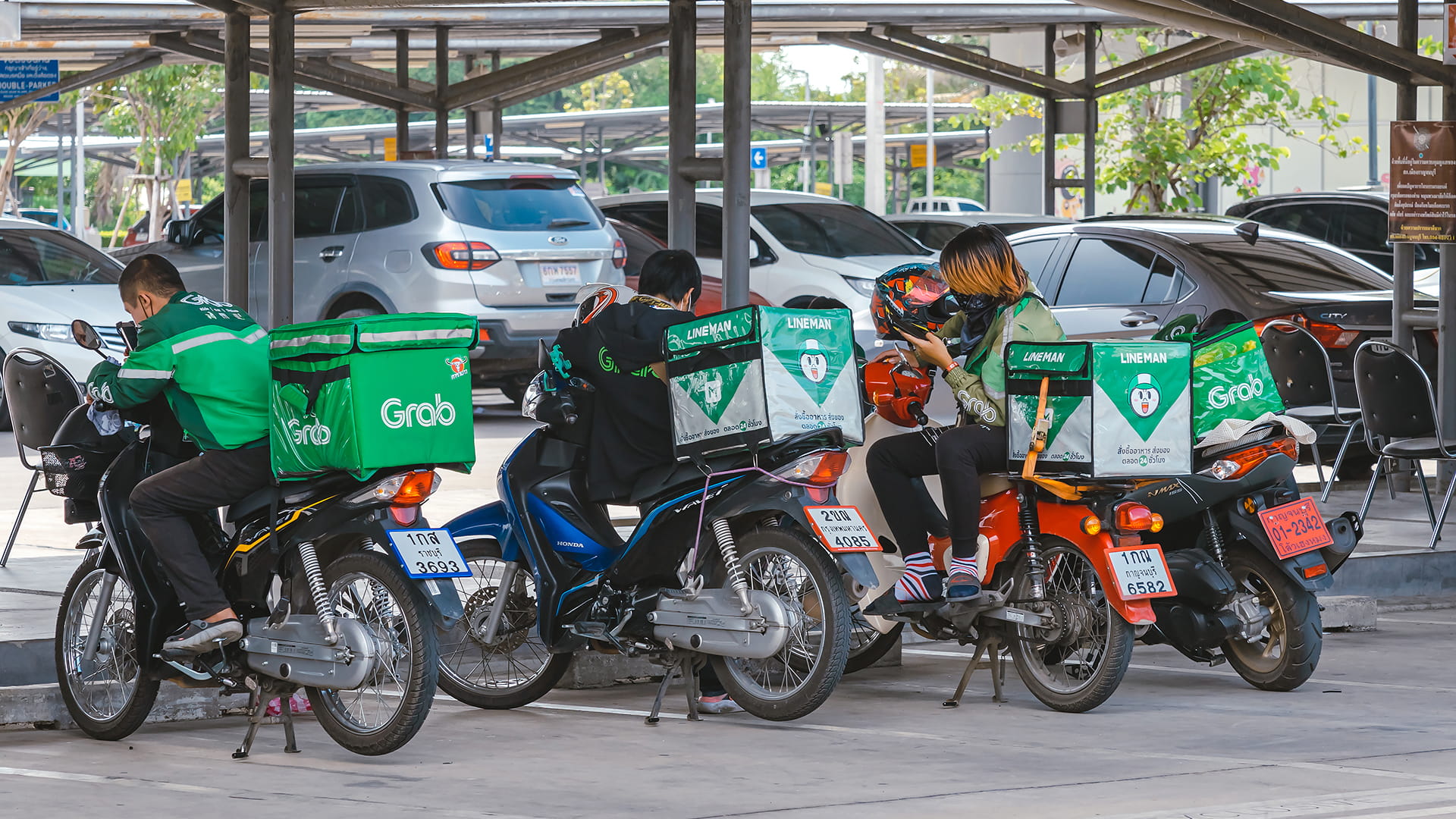
Unlike its main competitor, Grab, which is growing all across Southeast Asia, Line Man does not plan to expand outside the kingdom, Yod said.
“Our strategy right now is to go deeper into Thailand rather than to expand internationally,” he said. “We know the Thai market quite well. We will try to optimize our technology and we will localize as we understand each community.”
However, Thailand’s economic growth has been relatively weak, hurt by high household debt and rising fuel prices brought on by the US-Iran war.
While acknowledging “macroeconomic challenges,” Yod said he sees opportunities.
According to Momentum Works’ research, Thailand’s food delivery growth rate was the highest in the region, expanding 22% in 2025, outpacing Malaysia and Vietnam, both at 19%.
“Food delivery actually continued to grow at a fast pace even though the economy still has some challenges,” Yod said, adding that the weak economy encouraged people to eat at home, and food delivery—which tends to be less expensive than dining out in Thailand due to promotion deals—is a solution. “Food delivery remains very frequent and a very economical way to enjoy food compared to dining out.”
In the final quarter of 2025, Thailand introduced the “Khon La Khrueng” (half-half) shopping subsidy program, in which the government covers 50% of consumers’ spending for food and daily necessities to spur spending. Line Man joined the project, enabling its users to order food at subsidized prices.
The second phase of the shopping subsidy starts in June, and Yod said Line Man will join again. “We joined the Khon La Khrueng program last year, and we expect to do the same this year,” he said, adding that the company expects its revenue to grow “at least 20%” in 2026.
According to the company, its revenue for 2024, the latest year for which figures have been disclosed, was THB 16.7 billion (USD 512.3 million), up 44% from 2023. But it remained unprofitable with a net loss of THB 356 million (USD 10.9 million) that year.
Yod acknowledged that food delivery operators are engaged in an intense price war and that the competition will persist.
“I think we will always be in a price war,” he said. “Online food delivery platforms will continue to offer discounts … to give the best prices to users.” He added that this kind of “fair competition” can be expected in a growing market.
Kedsuda Inchai, a 38-year-old office worker in Bangkok, told Nikkei Asia she uses Line Man “because it has a lot of food options and its delivery price is quite cheap.”
Analysts say that although Thailand’s food delivery sector is growing rapidly, profit margins can be expected to remain slim due to intense competition.
“Grab uses promotions to offer discounts on food, while Line Man cuts the delivery price,” said Passakorn Wangwiwatcharoen, an analyst at Asia Plus Securities. “Both strategies squeeze profit margins.”
Passakorn added that cut-rate strategies are not sustainable.
Yuto Ikeuchi, a Bangkok-based consultant at Mitsubishi UFJ Research and Consulting, pointed out that Thailand’s food delivery operators are currently facing higher consumer prices and delivery costs that could affect demand and squeeze their margins.
“In addition, major players in the sector have been investing heavily in advertising and infrastructure to build their platforms,” he said, adding that “when these investments will begin to pay off remains a key concern for investors.”
This article first appeared on Nikkei Asia. It has been republished here as part of 36Kr’s ongoing partnership with Nikkei.
Note: THB figures are converted to USD at rates of THB 32.60 = USD 1 based on estimates as of May 29, 2026, unless otherwise stated. USD conversions are presented for ease of reference and may not fully match prevailing exchange rates.