
In late April, Manycore Tech listed in Hong Kong, with its shares surging nearly fourfold over two days. After 15 years as a home design technology company, during which it accumulated large volumes of 3D model data with real-world physical parameters, Manycore’s debut as the first publicly listed company among Hangzhou’s “six little dragons” added to the fanfare around “physical AI,” or artificial intelligence systems that interact with the physical world.
Less than a month later, another Hangzhou company appears to be approaching a similar moment. Unlike Manycore, it is targeting a more technically difficult field where usable data is scarce: 3D simulation for deformable objects.
In February, Style3D launched SynReal, its proprietary physics simulation and synthetic data system. The fashion technology company has spent about a decade accumulating 3D data on deformable objects, especially fabrics. SynReal is designed to reduce the cost of training embodied intelligence systems while increasing data throughput. For example, some of the technology behind Galbot’s laundry folding robot, which appeared during China’s televised Lunar New Year gala, came from Style3D.
Why is deformable simulation so difficult, and why do some researchers and companies regard it as a key challenge for embodied intelligence? Why would a fashion technology company move into robotics, and what might give it an edge?
The story begins with a deceptively simple task: folding laundry.
Robots still struggle to fold clothes
Robots are often viewed as mechanically capable. They can carry heavy loads, run long distances, and, in some cases, outperform humans in endurance events such as half-marathons.
Ask one to fold a piece of clothing, however, and the limits become clear. Faced with something as ordinary as a T-shirt, a robot may struggle to lay it flat, grip it steadily, fold it evenly, or complete the task at all.
A small number of companies have built robots described as capable of folding clothes. Their approaches generally fall into two categories.
- The first relies on hardcoded movement sequences. A garment is placed in a designated position, flattened in advance, and arranged properly before the machine performs a fixed set of motions.
- The second focuses on flexible grasping, allowing a robot to handle different garments and continue working even when humans interfere. But that approach is costly. According to 36Kr, building the required training data can require more than half a year of human operation and data collection. Once the scene, lighting, tabletop, fabric, or other conditions change, the resulting data may be difficult to reuse.
That raises a natural question: can computers build “virtual worlds” that follow the physical rules of the real world, then use those environments to train robots?
Several companies and platforms are already working in this direction, including Nvidia Isaac, Microsoft AirSim, and MuJoCo, which was acquired by DeepMind. Unlike large language models, this approach is closely tied to physical environments, which is why it is often described as physical AI.
Yet today, rigid body data dominates the field. Open a typical database and it is likely to be filled with cubes, robotic arms, and regular objects. These objects are easier to define and easier to compute.
The real world is not made only of rigid objects. From the clothes people wear to fruit in a supermarket, from a plastic bag crumpled in one hand to human skin itself, many everyday objects are, in practical terms, deformable.
A rigid object has a relatively predictable trajectory. Soft fabric is different. Every fiber can move in response to force.
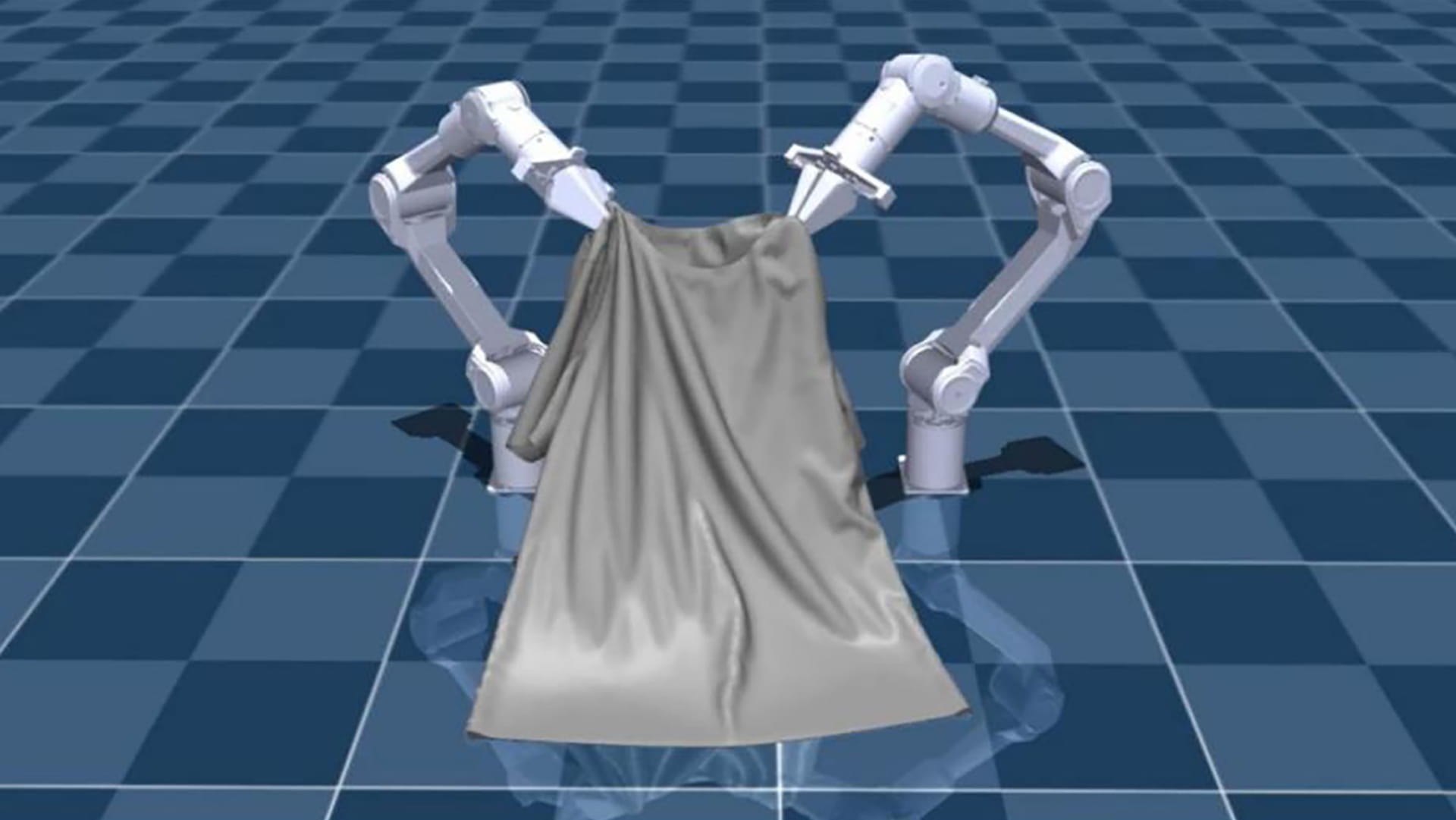
When a robot picks up a garment, even a tiny amount of force can trigger a chain reaction. Wrinkles form. Fabric drapes. A fold shifts the weight and tension across the entire object. In 3D simulation, an ordinary piece of fabric can be discretized into tens of thousands of vertices, with each vertex carrying multiple degrees of freedom. That creates a sharp increase in computation.
The problem becomes harder when deformable objects come into contact with each other, or with themselves. When clothes are folded, fabric repeatedly presses, bends, slides, and folds against itself. Modeling those interactions is computationally demanding.
This is why 3D deformable object simulation matters for embodied intelligence. The field has limited available data and high computational requirements, but it is difficult to avoid if robots are to operate reliably in real-world environments.
Fashion technology’s hidden advantage
Deformable object simulation has posed persistent challenges in robotics and computer vision. While much of the focus has remained on robotics companies and AI labs, a less obvious source of progress has emerged: 3D fashion technology.
How does virtual fabric drape? How does it flutter? How does it twist, bend, stretch, and fold when it touches another piece of fabric? These are rigorous physics simulation problems, and they are also the kinds of problems Style3D works on every day, generating data along the way.
Data accumulation alone is not enough.
Over the past decade, Style3D’s research team has invested in fundamental research on deformable object physics simulation. It has published research at major computer graphics conferences such as SIGGRAPH, covering areas including deformable body physics simulation, complex contact handling, and high-performance numerical computing.
Simulation could shape the limits of embodied intelligence
SynReal mainly consists of three parts:
- SynReal Sim, a high-fidelity simulation engine.
- SynReal Arena, an embodied intelligence training platform.
- SynReal Core, a training model based on large-scale synthetic interaction data.
Put simply, SynReal Sim creates a “virtual world” governed by physical rules. SynReal Arena gives robots a “virtual training ground.” SynReal Core helps robots learn from those simulated interactions.
Together, these components allow robots to train in virtual environments, potentially running millions, or even tens of millions, of exercises per minute as they learn how to interact with the physical world.
Another common approach to embodied intelligence training is to collect data manually through human demonstrations. That method is simpler to implement from a technical standpoint. Because the data comes from the real physical world, it also captures details and noise that can help robots adapt to real environments.
Its drawbacks are clear: it is expensive, slow, labor-intensive, and often difficult to generalize.
Human-supported data collection is often measured in months or years. Gathering high-quality demonstration data for a single task can require a professional team working for several months, with costs ranging from six- to seven-figure RMB sums.
A simulation platform, by contrast, can generate millions of data trajectories covering many variations within a few hours.
Compared with other physical AI simulation platforms, SynReal emphasizes three areas: accuracy, speed, and stability:
- In accuracy, Style3D said SynReal is supported by large reserves of rigid body and deformable 3D simulation data, allowing it to provide robots with training environments that are more realistic, more complex, and closer to the real world. The company added that SynReal can perform more accurate static and dynamic mechanics calculations, reducing errors by nearly 20% compared with the industry benchmark Isaac Sim.
- In speed, simulation throughput determines whether data generation can scale. Style3D’s technical team is said to have rebuilt the 3D deformable object simulation workflow around a GPU-based parallel computing architecture. The company said this makes SynReal five to ten times faster than Nvidia’s Isaac Sim, improving the efficiency of robot training.
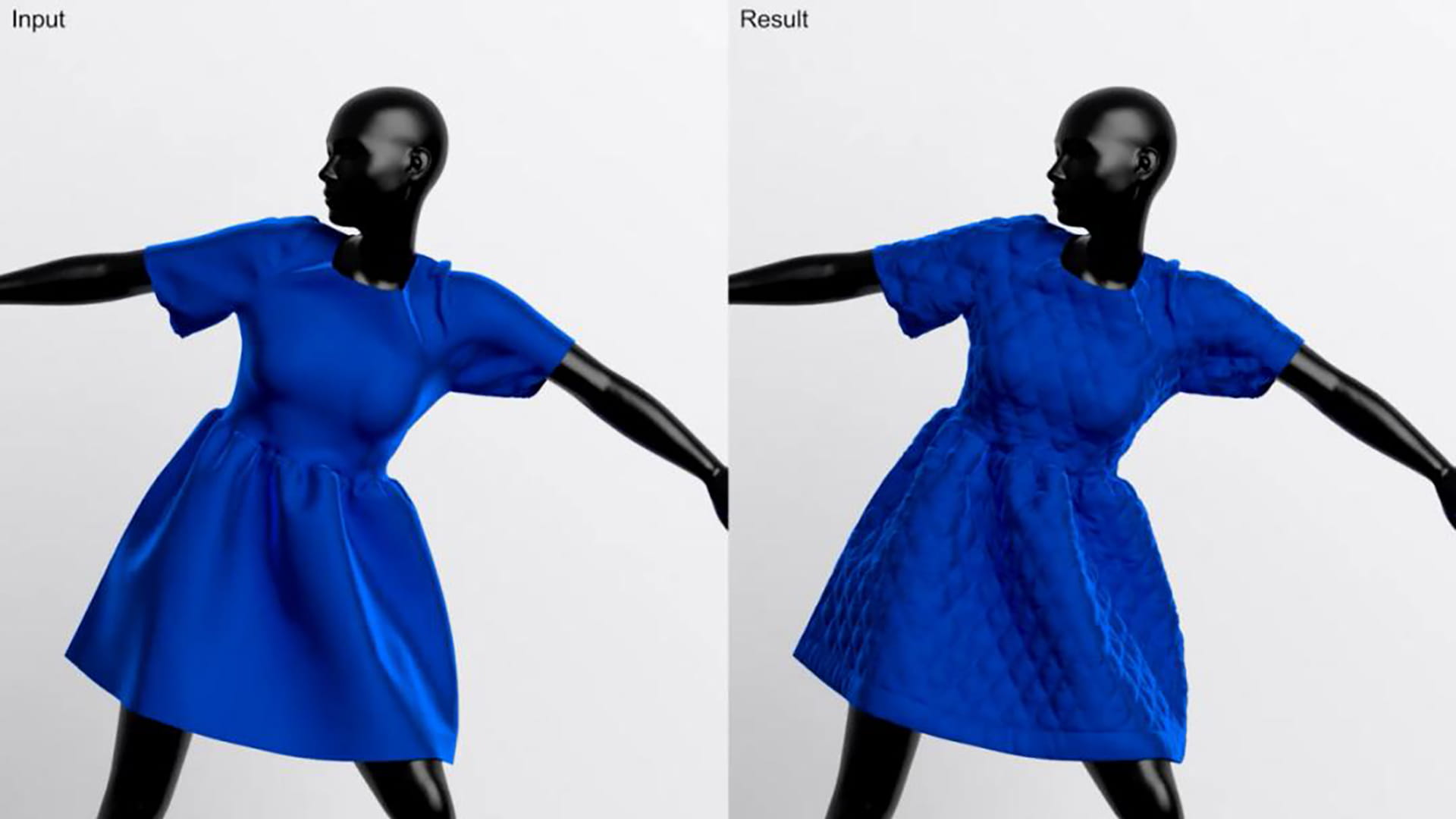
- In stability, the challenge is contact. When two or more deformable objects touch, the difficulty of modeling their interaction rises sharply. In 3D games, deformable objects such as hair and clothing are often prone to “clipping,” where objects visually pass through each other. To address this, Style3D’s technical team introduced a path-based computational method based on incremental potential contact (IPC), an approach presented at SIGGRAPH 2020. According to the company, this enables SynReal to maintain simulation stability even when multipoint, multilayer, and self-contact interactions change frequently, giving robots more stable learning results in complex scenarios.
As labor costs rise and demand for robot training data grows, massive volumes of lower-cost, high-quality simulation data are becoming increasingly important.
Only after repeated training in virtual environments supported by systems such as SynReal are robots likely to have a better chance of reducing costs and entering real-world scenarios, whether they are folding laundry, cooking, providing eldercare, or offering companionship.
Historical turning points are often driven by crossovers.
Nvidia began with graphics cards for gaming. Xiaomi started with smartphones for enthusiasts. Many technology companies have entered new markets by applying hard-won capabilities from one field to unresolved problems in another.
These crossovers bring different industry DNA. They use deep accumulation in one domain to solve persistent pain points in another. They are not always bound by established assumptions, and they can bring new tools and perspectives to old problems.
Deformable 3D simulation is becoming an important dividing line in embodied intelligence. Style3D, with its accumulated deformable 3D model data and simulation expertise, could be one of the more credible crossovers into this field.
KrASIA features translated and adapted content that was originally published by 36Kr. This article was written by Xiao Xi for 36Kr.