
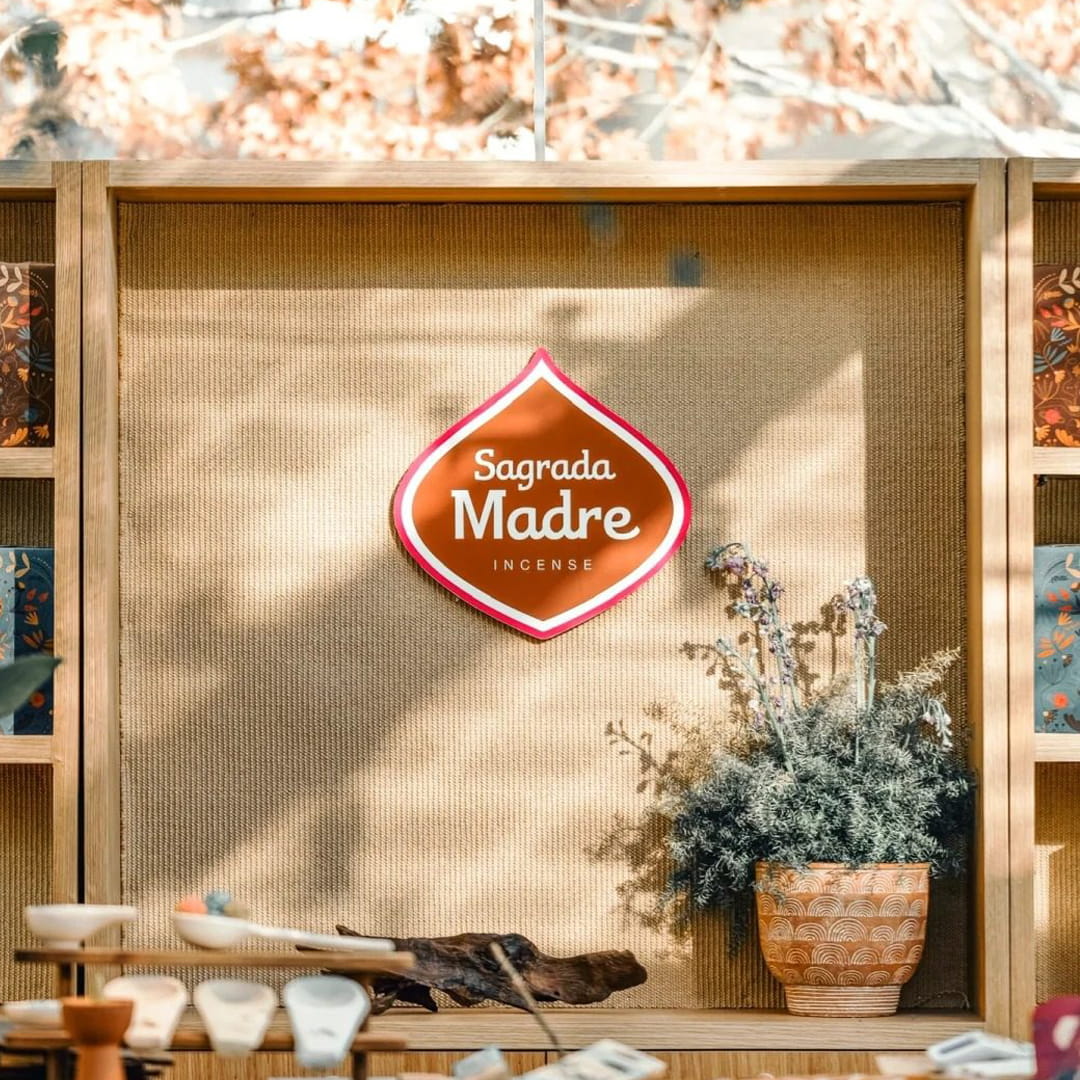
In the corridors of MixC Shenzhen Bay, one storefront stops passersby mid-stride. Washed in earthy reds and raw wood textures, the space feels less like a cosmetics counter and more like a fragment of South America transplanted into southern China. The air carries a dense blend of herbs and fruit, an aroma that is at once primal and invigorating.
This is one of Argentine incense brand Sagrada Madre’s stores in mainland China.
Just two years ago, its products were largely known among mainland Chinese tourists visiting Hong Kong, where they were purchased as niche souvenirs and carried home in suitcases. Today, the brand operates 15 counter stores across mainland China and plans to expand in 2026, adhering to what it describes as a quality-first principle. On Xiaohongshu, the company said its share of searches related to stick incense is approaching 30%, making it one of the most visible brands in the category.
Founded in Argentina, Sagrada Madre has expanded into more than 50 countries, including the US, the UK, Canada, Switzerland, and South Korea. The company expects annual global sales to exceed RMB 1.5 billion (USD 210 million). Its supply chain includes more than five self-built incense factories in Argentina and over 1,000 employees.
From a national brand in South America to a bestseller in Hong Kong concept stores, and now to a structured expansion in one of the world’s largest consumer markets, Sagrada Madre presents a case study in how an overseas brand can pursue both gradual market entry and rapid scaling in China.
The brand frames its mission around the belief that fragrance has transformative power and that all forms of life merit respect. That philosophy is seemingly embedded in its products. Sagrada Madre said it uses patented fruit biomass technology to convert discarded fruit pulp into incense material. The company reports using up to 100 tons of biomass annually. Its incense sticks are thick and visibly textured, with plant materials embedded in the surface.
“The incense culture of South America originated in communicating with spirits of nature, so its expression is intense, direct, and full of vitality,” Zhang Chi, Greater China CEO of Sagrada Madre, told 36Kr.
That aesthetic contrasts with the restrained and meditative qualities traditionally associated with East Asian incense culture, which often emphasizes subtlety and quiet elegance. In China, that difference has become part of the brand’s distinctiveness.
Before formally entering mainland China, Sagrada Madre had already built awareness through resellers and social media. Hong Kong served as its entry point.
“In Hong Kong, about 80% of Sagrada Madre’s consumers were mainland tourists,” Zhang said. “They discovered the brand there, but there was no stable path for repeat purchases. That was both our challenge and opportunity in entering the mainland.”
The brand began testing localization through two pop-up stores.
In November 2024, at Tianmuli in Hangzhou, Sagrada Madre recreated its South American-style store inside a transparent glass structure to assess whether Chinese consumers would respond to its original aesthetic. In April 2025, at MixC World Shenzhen, it introduced a brighter, more localized version aligned with the preferences of urban young consumers.
“From Tianmuli to MixC World, the proportion of customers who had previously seen or purchased the brand in Hong Kong rose from around 40% to 60–70%,” Zhang said.
According to Zhang, the results validated both preexisting brand awareness and the effectiveness of measured localization.
As more consumers seek products positioned around authenticity and emotional resonance, Sagrada Madre has expanded its footprint. It now operates 15 counter stores in mainland China, most located in the beauty sections of high-end shopping malls.
Mall operators, too, are reassessing fragrance as a category.
“In the past, malls wouldn’t place stick incense in the beauty zone,” Zhang said. “Now they recognize fragrance as another high-growth, high-stickiness category after beauty. Some leading malls even plan to increase the share of fragrance space from 10% to 30%.”
Despite expanding its retail channels, Zhang emphasized fixed principles.
“There are three things that will never change: natural sustainability, humanistic care, and environmental responsibility,” he said. “We will not participate in any collaboration involving harm to animals.”
Within those boundaries, the brand has pursued selective localization. In marketing, it has collaborated with M Stand to explore incense use beyond the home, positioning coffee shops as experiential spaces.
For gifting seasons and festivals in China, the company has developed boxed sets. Packaging and derivative products are designed and produced in China, while the incense sticks continue to be manufactured in Argentina.
The brand is also planning collaborations with Chinese traditional craft programs. Zhang said the founding team has a longstanding interest in Eastern philosophy, particularly the idea that humans and nature coexist in harmony. In his view, that concept aligns with South America’s reverence for the natural world. Localization, he said, is about identifying shared values rather than making superficial adjustments.
Online, Sagrada Madre operates across six major platforms, including Xiaohongshu, Douyin, Tmall, JD.com, Dewu, and Youzan. Together, these channels form a system spanning content discovery, purchase conversion, and membership retention.
Offline, the company follows one consistent practice: incense must be lit in-store.
“Scent is the most direct experience and the most powerful sales language,” Zhang said. “We communicate professionally with malls. This is low-temperature smoldering, not open flame.” Internal data reportedly shows a significant difference in conversion rates between stores that light incense and those that do not.
If its business stopped at stick incense, Sagrada Madre would at best remain a niche imported brand. However, its expansion plans extend beyond its core category.
According to 36Kr, the company’s 2026 strategy will focus on both category expansion and geographic growth.
On the product side, the Greater China team has secured group authorization to exclusively develop fragrance-based beauty and personal care products, as well as lifestyle items. It is co-developing its first body care product with its Argentina headquarters, with a release planned for the third quarter of this year.
“We’re starting with the body rather than the face because it aligns more naturally with our positioning around holistic healing,” Zhang said.
To support a broader portfolio, the company plans to open its first multi-level flagship experience store within the year.
For 2026, the company has set a target of achieving threefold growth. Its roadmap includes strengthening online omnichannel operations, expanding offline counters, launching a large-format store, and building a distribution network through partnerships with more than 100 high-end supermarkets, concept stores, and beauty collection retailers.
At the same time, Sagrada Madre’s Greater China operations will extend beyond the mainland. Thailand has been selected as its first stop in Southeast Asia. The move suggests that China may serve not only as a major sales market, but also as a testing ground for a retail model the company aims to replicate elsewhere.
KrASIA Connection features translated and adapted content that was originally published by 36Kr. This article was written by Ren Cairu for 36Kr.