
Interest in embodied intelligence has risen sharply since the start of this year, and that momentum is showing up in production and sales figures. In April, Agibot said its 10,000th robot had rolled off the production line, taking just over three months to grow from 5,000 to 10,000 units. Unitree Robotics’ IPO prospectus also offered a glimpse of its commercialization pace: RMB 1.707 billion (USD 250.1 million) in revenue in 2025, with shipments exceeding 5,500 units.
Behind these figures is the global expansion of Chinese robot makers that are competing on price and performance. Wang Xingxing, founder of Unitree Robotics, said at the 2025 World Robot Conference that overseas revenue had accounted for more than 50% of Unitree’s total revenue over the past several years.
Among these embodied intelligence companies, MagicLab has set an ambitious revenue target of USD 14 billion by 2036.
Its global ambitions have also pushed the company to bring its launch events to Silicon Valley. On April 28, MagicLab held the Global Embodied AI Innovation Summit (GEIS) in San Jose, a city that is home to companies including Adobe, TikTok, and IBM.
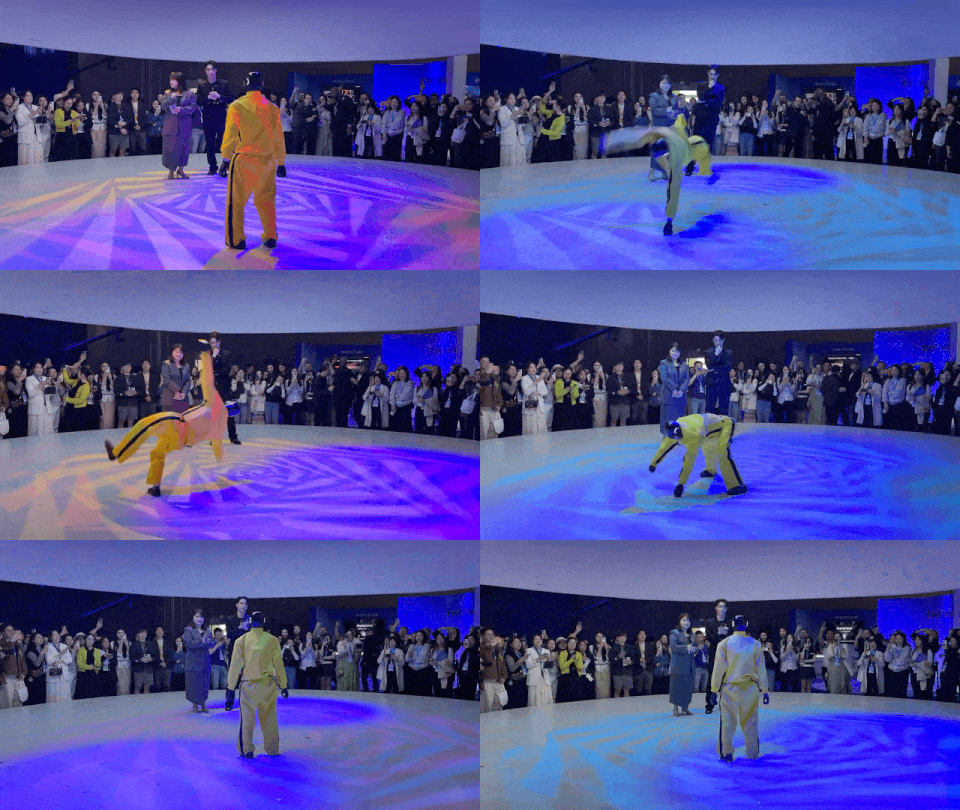
At the event, MagicLab released a series of new products spanning foundation models and robotic hardware including:
- Magic-Mix, described by the company as a world model, consists of two engines: Magic-WAM, which enables robots to learn to understand the real world, and Magic-Creator, which can generate large volumes of synthetic data offline. MagicLab said the system can continuously iterate through a closed loop of data generation, model training, real-world feedback, and further data generation.
- MagicHand H01, a dexterous hand, is equipped with 20 degrees of freedom (DoF), compared with roughly 24–27 DoF in a human hand. It also has 44 high-resolution 3D tactile sensors and is designed for fine manipulation in settings such as industrial manufacturing, services, and care.
- MagicBot X1, a humanoid robot, stands 180 centimeters tall and weighs 70 kilograms. It has 31 active DoF across its body and peak joint torque of 450 newton-meters. Built on a hot-swap system, X1 can operate continuously around the clock, according to the company. The product comes in standard and research versions. The standard version is designed for commercial deployment and turnkey use, while the research version targets universities, laboratories, developers, and industry partners. It supports secondary development at the foundation level as well as form-factor customization.
At the summit, embodied intelligence companies from Silicon Valley, including OpenMind, PrismaX, and Chestnut Robotics, also appeared on-site. These companies presented different approaches to robot intelligence, physical embodiment, and data.
Is synthetic data better than real-world data?
The scarcity of high-quality data has long been a bottleneck in training embodied intelligence models. At present, real-world robot data collection still faces high costs, long cycles, and limited scenario coverage.
Machine-generated synthetic data is one possible solution. But synthetic data has limitations because it often lacks real-world variables such as friction coefficients, latency, and tactile feedback. This has fueled industry concerns about the sim-to-real gap, or the difference between performance in simulation and performance in real-world environments.
Hybrid data training is the mainstream solution currently being proposed by embodied intelligence companies in both China and the US. During the summit, Gu Shitao, president of MagicLab, said the company collects about 16,000 pieces of data per day, then expands that volume 10,000 times through data synthesis. She added that new energy vehicle manufacturers offer a rich source of data collection because their product cycles are fast and 60–70% of their processes still depend on human labor.
The industry consensus is that the choice between real-world data and synthetic data depends on the training objective and application scenario.
Qi Haozhi, a scientist at Amazon Frontier AI & Robotics (FAR), said synthetic data is suitable for teaching machines a single basic reactive skill, but it is difficult for machines to acquire long-horizon skills, such as making breakfast, through synthetic data alone. In such cases, real-world data needs to be introduced into training because building a sufficiently rich simulation environment is costly.
Luo Zhengyi, a senior research scientist at Nvidia GEAR Lab, said his team currently uses about 50% simulation data for basic training, 15% motion capture data and 25% internet video data to understand human movement, and an additional 10% high-quality real-world data in training. He also said some companies use data from social media to guide robot embodiment design.
Is VLA the best architecture for embodied intelligence?
Because of its task generalization capability, VLA, or vision-language-action, has become one of the mainstream architectural paradigms for embodied intelligence models.
But VLA has limitations. When humans spin a basketball on a finger, for example, they rely mainly on touch and proprioception, the body’s ability to sense its own movement and position. They do not need vision. That points to gaps in VLA’s treatment of these two perceptual systems.
At GEIS, Amazon FAR’s Qi said VLA’s popularity is related to the current state of hardware sensors. Vision sensors are relatively mature, while tactile sensors are still in an early stage of development.
In his view, embodied systems need input from other senses to compensate for less mature sensor systems and maintain the operation of the robot body. As a result, VLA, which uses vision and language to offset tactile limitations, has become one of the strongest available solutions. But as sensors and hardware improve, algorithms are likely to evolve as well.
Dexterous hands face a three-way design debate
The central question in dexterous hand design is whether a robotic hand should resemble a human hand. Around this question, three design approaches have emerged: linkages, tendon-driven systems, and direct drive.
Linkages are the least humanlike, but they offer lower cost and easier control. Tendon-driven systems are the most humanlike and can perform fine manipulation, but they are costly and difficult to control. Direct drive is a compromise: it integrates the actuator directly into each joint. But it is not cheap, and it still faces engineering challenges in force transmission efficiency and thermal management.
Hybrid architectures have recently emerged as another technical path for dexterous hands. Evan Tao, founder of Chestnut Robotics and a former core member of the dexterous hand team for Tesla’s Optimus, said his team has chosen a hybrid architecture centered on tendon-driven structures capable of fine manipulation, supplemented by AI control and autonomous learning systems. Future solutions, he said, “will seek a balance between flexibility and engineering reliability.”
How can robots reach scaled deployment?
At the data layer, real-world data is still seen as important to helping robots understand application scenarios and learn to perform complex tasks.
Li Zizheng, CEO of XGSynBot, said the company’s hybrid data strategy still incorporates a small amount of high-quality real-world data. This keeps costs under control while improving model capability and generalization, he said.
At the system layer, Li said robots need to evolve from “single-function devices” into “multitask general-purpose platforms.” XGSynBot’s robotic arm, for instance, comes with a modular system featuring six quick-change modules. The benefit of this approach is that a single robot can switch among different processes, broadening the range of deployment scenarios.
Jan Liphardt, founder of OpenMind and an associate professor of bioengineering at Stanford University, summed up the deployment challenge this way: the sooner robots enter the real world, the better.
He has found that laboratory environments cannot simulate all the complexities of real-world settings, such as overly bright light, muddy and wet ground, rusty door hinges, and the load created when multiple systems run at the same time. These conditions often cause system failures after robots leave the lab.
For that reason, Liphardt argued, robots should not remain in laboratories until they are ready for deployment. Instead, he suggested placing robots in actual environments, including homes, schools, airports, kindergartens, and other public settings, as early as possible so they can collect interaction data and continue improving.
KrASIA features translated and adapted content that was originally published by 36Kr. This article was written by Zhou Xinyu for 36Kr.