
He Xing, vice president of Pony.ai and head of its robotruck business, said road freight is a market worth at least RMB 1 trillion (USD 147.9 billion), meaning that capturing even a small share could generate substantial economic value.
The freight industry also faces persistent problems, including a high rate of truck accidents, elevated operating costs, and a shortage of drivers. He said autonomous driving also pairs well with electric heavy- and light-duty trucks, potentially reducing energy use and emissions.
Pony.ai sees substantial overlap between robotrucks and robotaxis despite the freight market’s distinct applications. The two businesses can share resources across four areas critical to large-scale deployment: technology development, operations, regulation, and the broader industrial ecosystem.
He described robotrucks as an application of physical artificial intelligence, in which AI controls machines operating in the physical world. Their purpose is to transport goods while reducing the cost per ton-kilometer, or the cost of moving one metric ton of freight per kilometer.
“A truck is a physical transportation platform, and it uses the most advanced AI technology to achieve the goal of lowering costs,” He said.
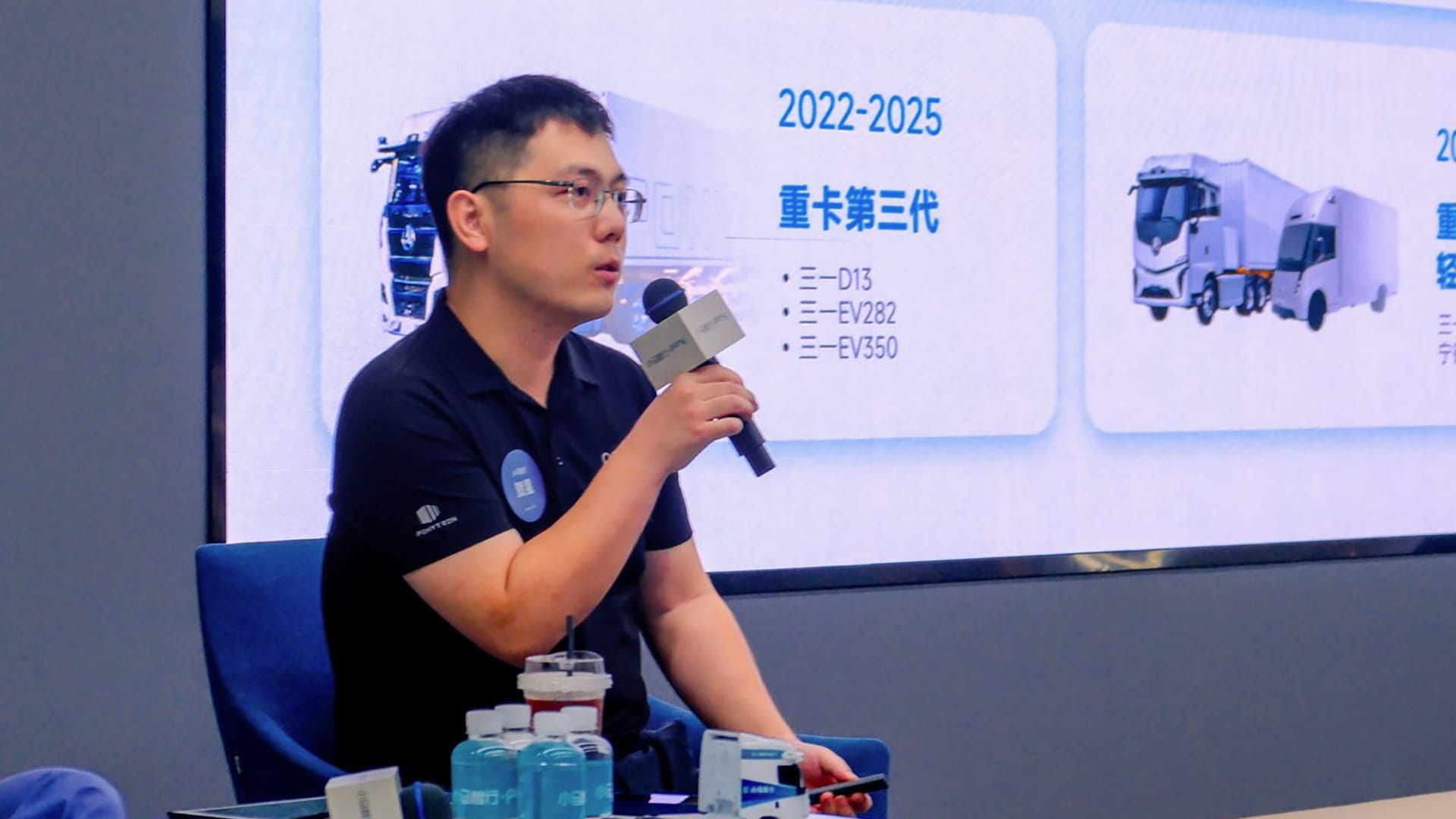
Autonomous driving could reshape traditional logistics in three areas: total cost of ownership, operating time, and the organization of logistics networks.
- First, vehicles are core transportation assets and a central part of the industry’s operating infrastructure. Their costs are typically assessed across their full lifecycles, including ownership and operation. Autonomous driving could alter several components of that cost structure.
- Second, a vehicle that can operate without a driver would not be constrained by human fatigue or driver working-hour limits. In principle, a driverless heavy-duty truck could operate around the clock, subject to charging, maintenance, and regulatory requirements. That could improve asset utilization and delivery times while reducing fatigue-related safety risks.
- Third, as autonomous technologies replace more human-operated processes, logistics networks, operating models, and supporting upstream and downstream services may reorganize around the new technology chain.
“Every advance in productivity reshapes the relationships around production,” He said. “Once a technology becomes standardized, many labor-intensive and fragmented businesses or markets begin to consolidate at scale. The industry eventually becomes more capital- and technology-intensive, with all factors of production increasingly organized around that system.”
He added that the business model could also become simpler and more direct.
“Once autonomous driving is achieved, a logistics fleet has access to a highly standardized transportation channel that is simple and readily available,” he said. “Transportation could truly become a service within the broader logistics process, as simple and convenient as using a mobile app to pay a household utility bill.”
Pony.ai launched its robotruck business in 2018 and introduced its first-generation heavy-duty truck in 2019.
In 2026, the company unveiled its fourth-generation heavy-duty truck amid a more mature trucking supply chain. He said the passenger vehicle market had already seen large-scale electrification and adoption of smart-vehicle technologies, while Pony.ai had begun producing robotaxis in batches of about 1,000 units.
According to Pony.ai, the fourth-generation robotruck kit uses 100% automotive-grade components and shares most of its parts with the company’s latest autonomous driving kit for robotaxis.
Pony.ai said the hardware cost for each truck’s autonomous driving kit is about 70% lower than that of the previous generation. The system has a designed service life of 20,000 hours and can support one million kilometers of freight operations.
“For an autonomous driving company, producing 1,000 vehicles is not merely a manufacturing milestone,” He said. “It means we have gradually begun using automotive-grade sensors and solutions, as well as large-scale design principles that are more closely aligned with vehicle production, to make autonomous driving systems factory-installed and embedded.”
“With that experience, we believe our heavy-duty trucks are now ready for large-scale production trials,” he added. “We have already achieved this level of production with passenger vehicles, and we are even discussing how to produce them at a much larger scale.”
He said large-scale passenger vehicle production had also deepened Pony.ai’s understanding of urban driving environments.
“Given Pony.ai’s safety standards, we believe we also have a strong advantage in entering the urban distribution market,” he said.
In addition to its fourth-generation heavy-duty truck, Pony.ai unveiled what it called the world’s first 100% automotive-grade, fully redundant Level 4 autonomous light-duty truck at the 2026 Beijing Auto Show.
The company said the vehicle offers advantages in scalability, economics, and efficiency:
- First, Pony.ai said the truck is more scalable because it offers Level 4 autonomy across all operating scenarios, an entirely automotive-grade system, and a fully redundant safety architecture.
- Second, the company said its freight cost per kilometer is 40–50% lower than that of human-operated trucks.
- Third, Pony.ai said the truck’s cargo capacity per trip is 2.6 times greater than that of low-speed autonomous delivery vehicles.
Pony.ai is positioning its fourth-generation autonomous heavy-duty truck for long-haul freight and is gradually expanding into port logistics.
Its light-duty truck will focus on express delivery, retail distribution, and cold chain logistics.
RELATED ARTICLE

Across both categories, Pony.ai said its underlying foundation remains the same principle it has followed since its founding more than a decade ago: using a single autonomous driving system across all vehicle types.
Discussing the company’s competitive barriers, He said Pony.ai’s robotruck strategy, whether applied to light- or heavy-duty trucks, is based on integrating its resources as efficiently as possible.
“Our capital efficiency and the speed of our technology iteration could be several orders of magnitude higher than those of competitors focused on a single vertical,” he said.
“We spend less from a cost perspective, while setting a higher benchmark in terms of capability,” he added. “For us, it is a good thing when more partners can thrive and the industry gains broader recognition. That helps us reach our ultimate goal by expanding the overall market.”
However, He acknowledged that the threshold for deploying robotrucks at scale, particularly heavy-duty trucks, is higher than it is for robotaxis.
“From another perspective, a high threshold is not necessarily bad for the industry,” he said. “If the threshold is too low, lower-quality operators can crowd out better ones. Companies may focus too heavily on cost and so-called scale, causing them to abandon features designed to ensure safety.”
“If a major accident occurs, it could have a devastating impact on the industry,” he added.
He said Pony.ai had continued developing autonomous heavy-duty trucks for years because its experience with world models, AI systems designed to simulate and predict how environments behave, and large-scale operations gave it confidence that it could clear that threshold.
“That is Pony.ai’s advantage and the result of its long-term accumulation,” he said.
According to He, Pony.ai expects to deploy 500–1,000 heavy-duty trucks over the next two to three years and 100,000 light-duty trucks by 2030.
This article was adapted based on a feature originally written by Stone Jin and published on IPO Zaozhidao. KrASIA is authorized to translate, adapt, and publish its contents.
Note: RMB figures are converted to USD at rates of RMB 6.76 = USD 1 based on estimates as of August 6, 2026, unless otherwise stated. USD conversions are presented for ease of reference and may not fully match prevailing exchange rates.