
Over the past five years, robotics development has advanced rapidly, with innovations reshaping nearly every aspect of human life. From factory floors to open fields, new systems are redefining what machines can do. In China’s far western region of Xinjiang, a team originally from Germany has applied aerospace engineering principles to create a heavy-duty, all-terrain modular robot built for rugged outdoor environments.
36Kr has learned that Percisphere, a Shenzhen-based robotics company specializing in large-load, all-terrain robots, has raised more than RMB 100 million (USD 14 million) in a pre-Series A funding round. The round was led by Dayone Capital, with participation from Anker Innovations and several existing shareholders. The proceeds will fund R&D, commercialization, and international expansion.
Founded in 2020, Percisphere chose Xinjiang’s harsh wilderness as its proving ground. Over five years, the team refined its products and technologies through repeated field trials guided by the needs of local agricultural operators. Using a modular design, the company scaled its technology for real-world deployment: the same components can be reassembled into two configurations: the T3000 for open fields, and the G3000 for orchards.
Citing market data, 36Kr reported that the global agricultural production services market—which includes mechanized plowing, planting, crop management, harvesting, and crop protection—was valued at USD 300 billion in 2024, with crop protection alone accounting for roughly USD 70 billion. Yet despite its size, traditional agricultural operations still face persistent challenges in efficiency and sustainability.
Percisphere’s decision to begin in Xinjiang’s agriculture sector reflects the contrast between the region’s striking natural landscapes and the ecological pressures caused by conventional farming practices. China leads the world in cotton yield per acre, and Xinjiang’s vast fields, often stretching for kilometers, are equipped with advanced drip irrigation and fertigation systems that have transformed saline land into productive oases. However, heavy pesticide use has created new issues including crop damage, soil compaction, and potential groundwater contamination. Some growers worry that if these trends continue, the land may no longer be arable within a few decades.
When Percisphere’s founding team returned to Shenzhen from Xinjiang, they brought back not only a clod of soil from a cotton field in Shihezi but also a commitment to develop products grounded in the realities of Xinjiang’s agriculture.
Each year during the spring planting season in March, the company’s R&D team relocates to Xinjiang’s cotton fields, returning only in October. Over five years, the team developed five major iterations and more than 30 minor revisions, logging over one million kilometers of field testing. The result is a robust, transformable chassis and modular payload system. It is one of the few fully electric, all-terrain deformable platforms in the world capable of carrying up to three tons, climbing 27-degree slopes continuously, and operating for eight hours on a single charge.
To address pesticide overuse, Percisphere developed a 20-meter-wide precision spraying module that, when mounted on its all-terrain platform, forms the T3000 configuration.
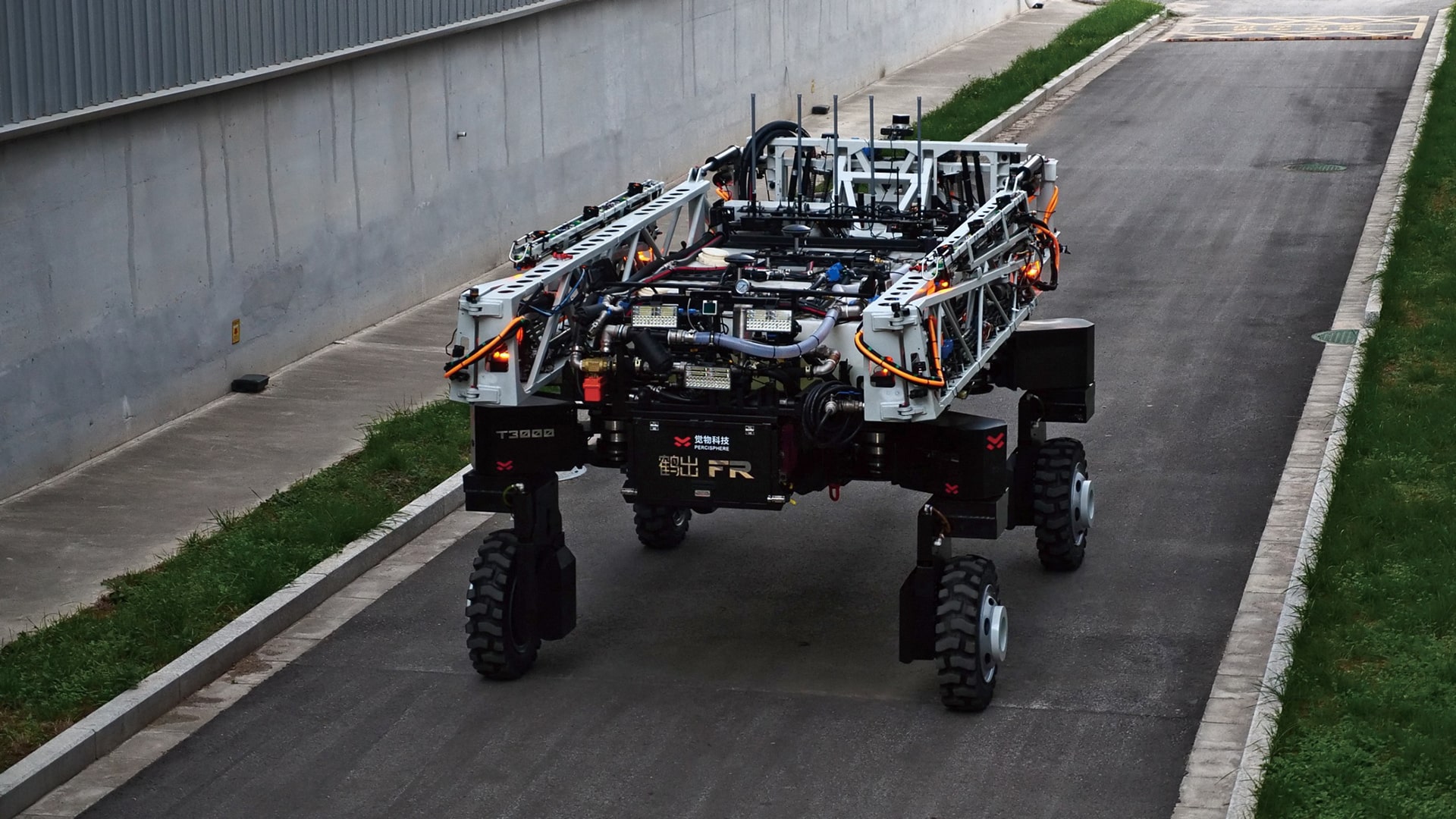
Equipped with 18 cameras and 111 independently controlled nozzles, the system supports three spraying modes:
- Row-targeted spraying, which treats only crop rows during early growth stages.
- Targeted spraying, which applies herbicides exclusively to weeds before crop emergence.
- Variable spraying, which adjusts spray volume based on pest density and plant height in later stages.
These modes increase efficiency while minimizing chemical waste.
To adapt to different crop types and growth stages, the robot’s chassis automatically adjusts its wheelbase and track width between 1.0–2.5 meters, ground clearance from 1.2–1.5 meters, and boom height from 0.3–1.8 meters. Its rotating adaptive transformation mechanism, combined with 360-degree mobility and wheel-edge drive technology, enables “Z-shaped” motion: moving forward, shifting laterally at the field’s edge, then reversing without turning. This design minimizes crop damage often caused by traditional machinery when turning at row ends.
In essence, a single robot can perform multiple functions across varied environments and growth cycles. By swapping payloads, it can transition smoothly between applications, significantly improving efficiency compared with specialized single-purpose machines.
When the T3000 swaps its field-spraying module for an orchard configuration, it becomes the G3000. In August, the orchard robot debuted at Chateau Changyu Rena, a vineyard in Yantai, where its advantages in adaptability and precision were most evident.
Beyond its transformable chassis, which lets it navigate narrow orchard rows, the G3000’s spraying module features a multi-joint profiling structure covering up to eight meters vertically and ten meters horizontally. Equipped with eight binocular depth cameras, it can identify fruit clusters and pest-affected leaves for bidirectional precision spraying. Each nozzle is independently controlled, adjusting water output based on tree size and pest severity. The system improves pest-control efficiency by 40% compared with manual operations. The G3000 can also be fitted with additional modules to perform fertilization, automated pruning, soil covering, and orchard cleaning.
Commercially, Percisphere’s robots are already operating across several provinces in eastern and western China, with contracts valued in the tens of millions of RMB. Overseas interest has also grown, particularly in Australia and Canada, where large-scale farms face chronic labor shortages. The company believes its autonomous, deformable robotic systems can meet the operational demands of these markets.
Percisphere has begun its international expansion and plans to bring both the T3000 and G3000 to global markets by next year.
KrASIA Connection features translated and adapted content that was originally published by 36Kr. This article was written by Li Xiaoxia for 36Kr.