
On March 9, Creality refiled its prospectus with Hong Kong Exchanges and Clearing for a main board listing, with China International Capital Corporation as its sole sponsor. The filing marks the company’s third attempt to go public. If approved, it would become Hong Kong’s first listed consumer 3D printing company.
The prospectus also shows how much the market has changed. Creality, once the category leader, has lost share to Bambu Lab as competition shifts from low-cost hardware to speed, ease of use, and software. Revenue has continued to grow, but profit has narrowed and operating cash flow turned negative in 2025.
That raises two questions. Is consumer 3D printing an attractive business? And does Creality still merit close attention?
Is 3D printing a good business?
Before looking at Creality, it is worth asking whether consumer 3D printing is an attractive market at all.
The investment case has rested on two ideas. The first is that easier design tools and lower printing costs could expand the market beyond hobbyists. The second is that software, communities, and consumables could make the business more durable and profitable than hardware alone.
As demand shifts from standardized goods toward more customized products, distributed manufacturing has attracted more attention. Consumer 3D printers fit that trend because they allow faster iteration and smaller production runs.
For years, adoption was limited by difficult modeling, high material costs, and low success rates. Generative artificial intelligence tools for design and slicing, along with cloud-based model libraries and user communities, have started to lower those barriers. Improvements in hardware and materials have also reduced costs and widened the range of use cases.
According to China Insights Consultancy, the global consumer 3D printing market was worth USD 4.1 billion in 2024 and is expected to reach USD 16.9 billion by 2029, implying a compound annual growth rate of 33%.
The sector has also become more attractive because scale is concentrated. The top five consumer 3D printing companies, all Chinese, account for more than 70% of gross merchandise value (GMV). That concentration reflects supply chain advantages, manufacturing scale, and early technology gains, and it raises the barrier to entry.
Leading brands are also trying to increase switching costs through proprietary software and model sharing communities. Once users begin designing, printing, and sharing within one ecosystem, they are more likely to keep buying that brand’s consumables, accessories, and software services. Those revenue streams are generally less cyclical than printer sales and can carry higher margins.
That helps explain why investors do not see the category as pure hardware. For the strongest companies, the question is whether a printer sale can lead to a longer-term relationship built around software, content, and consumables.
Creality loses ground to Bambu Lab
Creality sells 3D printers, consumables, 3D scanners, laser engravers, accessories, services, and finished products. According to the prospectus, its revenue rose from RMB 1.346 billion (USD 195.1 million) in 2022 to RMB 3.13 billion (USD 453.7 million) in 2025, a compound annual growth rate of 32.4%.
3D printers remained its main source of revenue, although their share fell to 57% in 2025. Consumables and 3D scanners contributed a growing share and may provide additional growth.
Geographically, the company’s revenue mix has shifted away from China, including Hong Kong, Macao, and Taiwan, and toward North America and Europe. In 2025, North America and Europe accounted for 57.3% of revenue, while China accounted for 25.9%. Overseas markets have become a more important growth driver.
Its channel mix has also changed. Online direct sales rose from 35.7% of revenue in 2023 to 48.5% in 2025. In China, the company relies mainly on Tmall and JD.com. Overseas, it has focused more on direct-to-consumer sales, supported by Amazon and eBay.
Overall revenue growth has remained solid. But the picture looks weaker in the core printer business.
From 2022–2025, revenue from Creality’s 3D printer business grew at a compound annual rate of 17%, well below the company-wide pace. In 2024, revenue from that segment rose just 0.9% year on year. The increase in printer revenue over the past several years came mainly from higher average selling prices rather than volume growth. From 2022–2025, the average selling price of Creality’s 3D printers rose from RMB 1,306 (USD 189.3) to RMB 2,404, (USD 348.5) but unit sales fell from 842,000 to 742,000. Gross margin in the core printer business also narrowed as competition intensified.
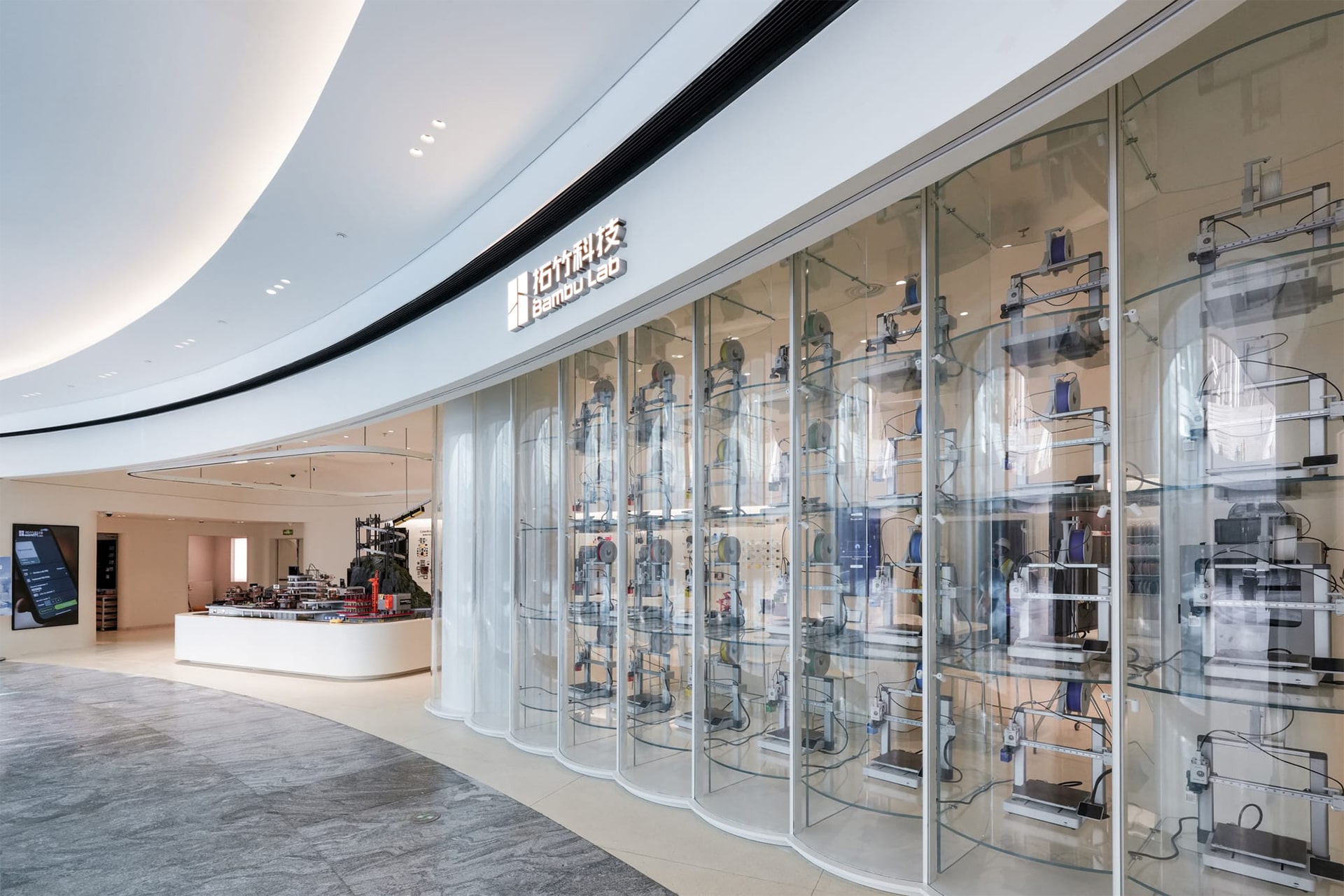
That shift is closely tied to Bambu Lab. In May 2022, it launched the X1, bringing higher-speed and multicolor printing to the consumer market. The product helped shift competition away from basic value pricing and toward performance, ease of use, and software integration.
Creality’s market share has since contracted. In 2024, Bambu Lab shipped 1.2 million units and held 29% market share, overtaking Creality. Creality’s market share fell to 16.9%. On a GMV basis, the gap was wider: Bambu Lab recorded RMB 730 million (USD 105.8 million) and a 35.5% share, while Creality recorded RMB 230 million (USD 33.3 million) and an 11.2% share.
Creality’s value strategy reaches its limit
Creality’s position today is partly the result of the strategy that built it.
In the early maker market, consumer 3D printers were split between expensive industrial systems and lower-cost machines that still required heavy DIY assembly and modification. Most users wanted something affordable, functional, and large enough for practical prints.
Creality met that demand. In 2016, it launched the CR-10S, which addressed full single-run prints at roughly half the price of comparable Western products. In 2018, it followed with the Ender-3, which broadened access to entry-level 3D printing. Low prices and acceptable performance helped the company scale quickly. From 2020–2024, it shipped a cumulative 4.4 million units and held 27.9% market share.
That growth reflected a classic hardware playbook: use manufacturing scale and supply chain efficiency to lower prices, expand the market, and fund product upgrades. That approach worked when buyers mainly cared about affordability and basic functionality.
After 2022, the basis of competition changed. New entrants such as Bambu Lab made speed, automation, multicolor printing, and software integration more important. Consumer printers also became easier to use, which expanded the market beyond enthusiasts.
Creality was slow to adjust. While Bambu Lab focused on algorithms, ecosystem design, and user experience, Creality remained more focused on hardware volume and pricing. It did not launch the K1 series until May 2023. By then, Bambu Lab had already taken much of the category’s attention, leaving Creality in catch-up mode.
Creality’s response is getting expensive
Creality has since tried to respond on three fronts.
First, it increased R&D spending. From 2022–2025, R&D expenses rose from RMB 87 million (USD 12.6 million) to RMB 222 million (USD 32.2 million), while the R&D ratio increased from 6.4% to 7.1%. That spending supported faster product updates and a push into higher-end models such as the K1 Max and K2 Plus. The company has also expanded into adjacent categories, including laser engraving and 3D scanning.
Second, it raised selling expenses to support direct sales and brand marketing. As part of that shift, it moved away from heavier reliance on distributors and increased spending on social media and e-commerce channels.
The channel strategy changed quickly. Online sales as a share of total sales rose from 14% in 2022 to 49% in 2025. But the cost was high. Marketing and advertising expenses rose from RMB 30 million (USD 4.3 million) to RMB 270 million (USD 39.1 million) over the period, while platform commissions increased from RMB 2 million (USD 289,892.9) to RMB 96 million (USD 13.9 million). As a result, the selling expense ratio climbed from 8.1% to 18.2%.
Third, Creality has tried to strengthen its software and community offering. It launched Creality Cloud in 2020, but for years the platform functioned more as a hardware add-on than as a core content and user retention product.
That changed after 2023, when MakerWorld became a major model sharing platform. Creality increased investment in Creality Cloud and added AI features. By the end of 2025, Creality Cloud had more than 5.7 million registered users globally. The company has also launched Nexbie, a 3D product e-commerce platform intended to connect hardware, software, content, and transactions.
Some of those efforts showed up in 2025. Printer unit sales rose from 720,000 to 740,000, and printer revenue increased 26% to RMB 1.78 billion (USD 258.0 million).
RELATED ARTICLE
But the recovery brought new pressure. Higher marketing and R&D spending weighed on earnings. In 2025, gross margin held at 31%, but operating profit and net profit both slipped slightly into the red. The company attributed part of the result to a one-off dividend payout, yet the decline in core operating profit still points to weaker profitability.
The same strain is visible in cash flow. In 2025, net cash flow from operating activities turned negative, with an outflow of RMB 63.977 million (USD 9.3 million). That suggests the business was no longer generating enough operating cash to fully support day-to-day needs.
That matters because the competitive pressure is not limited to Bambu Lab. Companies such as Anker and Dreame are also moving into the market. They still trail the leading players in 3D printing technology and product depth, but their manufacturing and channel capabilities could make competition tougher.
There is also a longer-term risk around IP. Model sharing communities help lower the barrier to entry by giving users access to ready-made designs. But recent copyright friction between Bambu Lab and Pop Mart highlights a gray area in the business. If rights holders increase enforcement, compliance costs for platforms could rise significantly. For Creality, which is already under pressure on margin and cash flow, that is another risk investors will have to weigh.
KrASIA features translated and adapted content that was originally published by 36Kr. This article was written by Ding Mao for 36Kr.
Note: RMB figures are converted to USD at rates of RMB 6.90 = USD 1 based on estimates as of March 25, 2026, unless otherwise stated. USD conversions are presented for ease of reference and may not fully match prevailing exchange rates.