
China Unicom and Huawei have deployed a dedicated 5G-Advanced (5G-A) network at the second World Humanoid Robot Games, putting some of Huawei’s recent mobile networking ideas into practice.
The games opened on August 22 at Beijing’s National Speed Skating Oval and are scheduled to run through August 26. They feature 2,056 humanoid robots from 666 teams taking part in 1,301 competition sessions across 51 events, up from 26 events at the inaugural games, according to official figures.
This year’s program also places greater emphasis on autonomous and complex tasks. New head-to-head events include table tennis and kickboxing, while scenario-based competitions cover industrial production, hotels, homes, and logistics.
These activities place particular demands on the network. Robots need to transmit telemetry and exchange control signals, while some tasks require multiple machines to coordinate their movements in real time.
To support these workloads, China Unicom and Huawei deployed a dedicated 100 megahertz network alongside a 300 MHz LampSite system, Huawei’s technology for distributing cellular coverage and capacity across large indoor venues.
The companies also allocated dedicated network resources to robot traffic. They said the setup kept end-to-end latency below 30 milliseconds, while on-site tests recorded peak uplink speeds of one gigabit per second.
The two figures address different requirements. Low latency reduces delays in sending and receiving time-sensitive information, while greater uplink capacity allows robots to transmit larger volumes of telemetry and other data to the network. Huawei and China Unicom said these capabilities support tasks including multi-robot coordination, obstacle avoidance, and fine-motion control.
The network is also integrated with the BeiDou satellite navigation system, China’s equivalent of GPS, using real-time kinematic technology to provide decimeter- to sub-decimeter-level positioning accuracy.
The deployment offers a glimpse of why telecommunications companies are paying closer attention to uplink performance as artificial intelligence-enabled devices become more common.
Mobile networks have traditionally been designed around consumers downloading data, such as videos and webpages. AI-enabled devices can alter that traffic pattern because they may also need to send large volumes of information back to the network for processing or interaction.
Huawei highlighted this shift at Mobile World Congress (MWC) Shanghai in June, where it argued that AI-enabled devices and applications would place greater demands on mobile uplink capacity. The company has identified stronger uplink capabilities as a key part of 5G-A networks designed to support what it calls the “mobile AI era.”
The World Humanoid Robot Games provide a more concrete example of that argument. A humanoid robot can act as a mobile source of telemetry and other data, while some functions can depend on timely communication between the robot and external systems.
The games also demonstrate how 5G-A can support robotics workloads, although the extent to which humanoid robots will depend on network connectivity will partly hinge on how computing is divided among the robot, edge infrastructure, and the cloud.
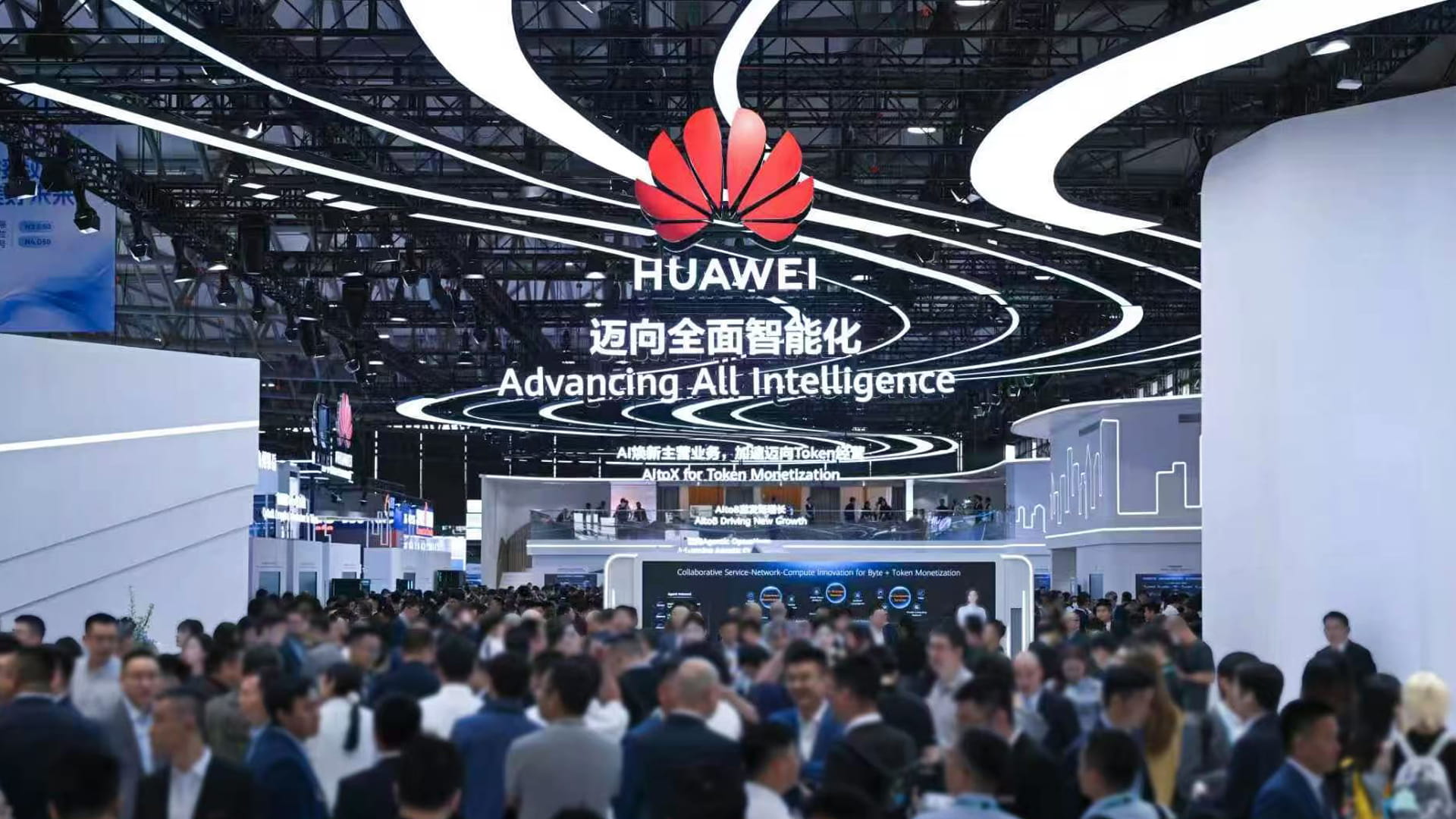
Huawei has been building its network portfolio around the expectation that AI will increase demand for capacity. At MWC Barcelona in March, it introduced a U6GHz portfolio spanning macro sites, small cells, and microwave equipment. The wider spectrum is intended to provide greater network capacity, although higher frequencies also introduce coverage challenges.
Beyond connectivity, China Unicom has developed what it describes as China’s first embodied robot management platform for event scenarios. Each robot is assigned a network ID, allowing staff to monitor its location, competition status, and operational metrics.
Yang Lifan, Beijing deputy general manager of China Unicom, said the games would help the carrier gain network assurance experience for larger-scale deployments of embodied intelligence.
Huawei plans to continue working with China Unicom on uplink capacity, spectrum coordination, and differentiated network services for device-to-cloud transmission, according to David Li, president of Huawei’s Wireless TDD product line.