
Alibaba is preparing for another step up in artificial intelligence infrastructure spending, unveiling a new proprietary accelerator as it targets more than 20 gigawatts of global data center capacity by 2032.
The Zhenwu V900, developed by Alibaba’s chip unit T-Head Semiconductor, is scheduled for commercial release in the first quarter of 2027. Alibaba said the chip delivers three times the performance of its previous-generation M890, with 216 gigabytes of memory and inter-chip bandwidth of 1,200 gigabytes per second.
The announcements extend Alibaba’s effort to control more of the computing stack behind its AI business. But as demand for AI cloud services grows, so does the capital required to support it.
RELATED ARTICLE
Alibaba spent RMB 67.7 billion (USD 10.1 billion) on capital expenditures in the June quarter, up 75% year-on-year and 151.6% from the previous quarter. The company attributed the increase partly to continued investment in AI infrastructure, including additional CPU computing capacity and higher prices for chip components.
Free cash flow was negative RMB 44.7 billion (USD 6.7 billion) in the same quarter, compared with an outflow of RMB 18.8 billion (USD 2.8 billion) a year earlier. Alibaba said the deterioration was mainly due to increased spending on cloud infrastructure.
The higher spending has coincided with faster cloud growth. Revenue from AI cloud and compute services increased 44.9% year-on-year to RMB 48.4 billion (USD 7.2 billion) in the June quarter, while AI-related product revenue reached RMB 12.4 billion (USD 1.8 billion), marking a 12th consecutive quarter of triple-digit growth.
Cloud profitability also improved. Adjusted EBITA rose 133% year on year to RMB 5.7 billion (USD 849.5 million), lifting the margin to about 12%. During Alibaba’s August earnings call, CEO Eddie Wu pointed to the company’s full-stack AI strategy as a way to capture demand for both AI services and the computing infrastructure underpinning them.
Alibaba is now planning that infrastructure on a substantially larger scale. The company said its global data center capacity will exceed 20 GW by 2032, supporting what it describes as an “agentic cloud” spanning computing infrastructure, foundation models, and AI agents.
At the hardware layer, the V900 will form part of Alibaba’s next generation of Panjiu supernodes. Alibaba said an upgraded Panjiu system will combine the V900 with other proprietary components, including its XuanTie C930 server CPU and Zhenwu ICN 2.0 interconnect chip.
According to Alibaba, the architecture can scale into clusters containing as many as 500,000 accelerator cards.
Developing its own chips could have implications beyond computing capacity. Alibaba has previously linked greater adoption of T-Head hardware to the economics of its cloud business.
During its earnings call for the March quarter, Wu said wider deployment of T-Head chips could support cloud gross margins over time. Alibaba has since reported faster cloud growth and higher cloud margins, although its broader infrastructure buildout continues to consume substantial capital.
The V900 extends that strategy. Rather than relying solely on externally sourced accelerators as its infrastructure requirements increase, Alibaba is building more of the hardware that sits beneath its cloud services and AI models.
Its proprietary compute roadmap is also expanding beyond AI accelerators.
Alibaba plans to introduce two new Yitian processors in 2027. The Yitian 720 is designed for cloud computing and AI inference, while the higher-performance Yitian 730 will target workloads including high-performance computing, data analytics, and databases.
The hardware expansion is arriving alongside another increase in the planned scale of Alibaba’s Qwen models.
Alibaba said Qwen 4 is now in training, while subsequent Qwen 4.5 and Qwen 5 models are expected to scale to between five and ten trillion parameters. The company has not disclosed when those models will be released.
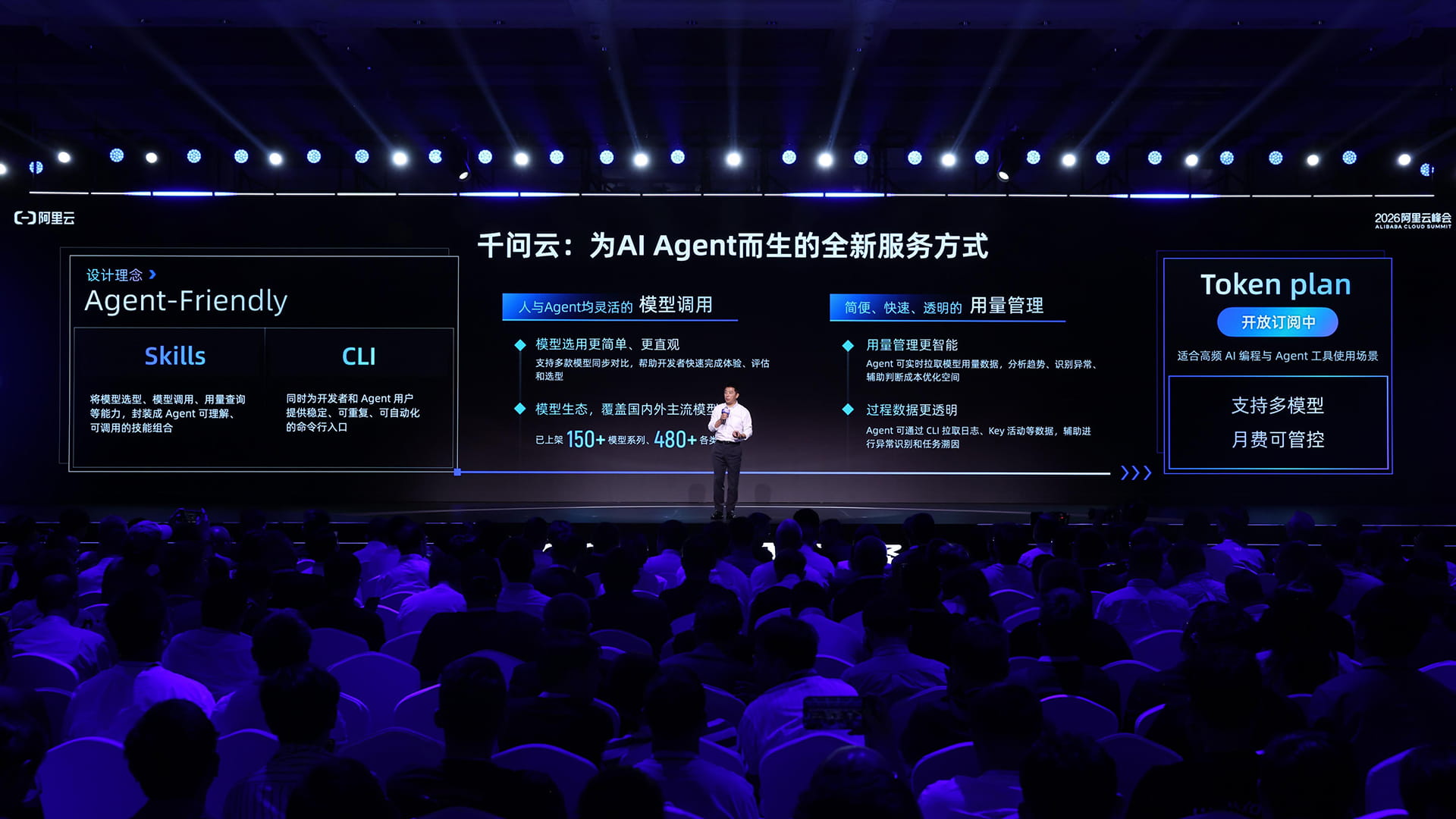
Larger models are only one source of the computing demand Alibaba is preparing to serve. The company has increasingly focused its cloud business on AI agents, particularly coding applications, which can consume substantially more tokens than conventional chatbot interactions.
In the first five months of 2026, revenue from Alibaba Cloud’s model-as-a-service token usage reportedly increased 15-fold, with monthly revenue reaching a nine-figure RMB sum. Alibaba has said agentic workloads are driving much of that increase.
The strategy creates a potentially reinforcing, but capital-intensive, cycle. More capable models and agents can increase cloud usage, while supporting that usage requires additional chips, servers, and data center capacity. Developing more of those components internally could give Alibaba greater control over its infrastructure and costs. Its reported cloud margins have improved even as infrastructure spending has weighed on group-level cash generation.
Note: RMB figures are converted to USD at rates of RMB 6.71 = USD 1 based on estimates as of September 22, 2026, unless otherwise stated. USD conversions are approximate and, where appropriate, rounded for ease of reference. They may not fully match prevailing exchange rates.