
On the same day, Laopu Gold disclosed financial results that many of its peers could only envy. For full-year 2025, it reported sales of RMB 31.375 billion (USD 4.6 billion), up 220.3% year-on-year (YoY), and revenue of RMB 27.303 billion (USD 4 billion), up 221%. On a non-IFRS basis, adjusted net profit reached RMB 5.029 billion (USD 734.5 million), up 234.9%.
The company attributed the surge to three factors:
- Its brand influence expanded, strengthening its market position.
- Product launches and optimization drove growth across online and offline channels.
- It also added new stores.
Last year, Laopu Gold operated 45 stores across 16 cities, including Singapore and Hong Kong. Compared with 2024, ten new stores, along with nine upgraded and expanded locations, contributed incremental revenue. Based on offline store sales of RMB 25.793 billion (USD 3.8 billion), average annual sales per store exceeded RMB 500 million (USD 73 million).
Citing Frost & Sullivan data, the company said it ranked second by revenue among global luxury brands in mainland China, and first in sales per store and per square meter within a single mall.
Its customer base is increasingly overlapping with that of five major luxury brands, including Louis Vuitton, Hermes, and Cartier. That overlap rose from 77.3% in July last year to 82.4% in March this year.
Shortly after releasing its 2025 annual report, Laopu Gold issued first-quarter guidance. It forecast sales of about RMB 19–20 billion (USD 2.8–2.9 billion), including tax, revenue of RMB 16.5–17.5 billion (USD 2.4–2.6 billion), and net profit of about RMB 3.6–3.8 billion (USD 525.8–555.0 million), close to 60% of its full-year 2025 performance.
These results suggest that while three major luxury groups face varying degrees of pressure, Laopu Gold, a newer entrant, has gained ground. European luxury houses have taken notice.
In a research note on Richemont, Morgan Stanley said Chinese high-end brand Laopu Gold poses a growing competitive threat to Cartier. At an earnings briefing in May last year, Richemont CEO Nicolas Bos acknowledged its market relevance, saying it adds desirability and vitality to the jewelry sector. Bernard Arnault, chairman and CEO of LVMH, visited Laopu Gold’s store at Shanghai IFC during a China trip, describing it as “exquisite” and “interesting.”
And that raises the question: is Laopu Gold ready to stand alongside international luxury brands?
Breaking open a gap in consumer perception
Laopu Gold’s success stems in part from breaking away from the category it originated in. Historically, gold jewelry pricing closely tracked raw material costs, typically following a formula of gold price plus processing fee. This created a structural constraint, as brand premiums rarely offset rising input and labor costs during periods of sharp increases in international gold prices.
Once gold prices pass a certain threshold, consumers often delay purchases rather than chase further gains.
Market data reflects this shift. Beginning in 2023, sustained central bank buying, rising geopolitical risk, and expectations of US Federal Reserve rate cuts pushed gold prices higher. In 2025, prices climbed from USD 2,646 per ounce at the start of the year to nearly USD 4,500 by year’s end.
The surge split the gold jewelry market. Traditional brands that rely on weight-based sales, including Chow Tai Fook and Chow Tai Seng, saw revenue decline.
Financial filings show that in fiscal 2024, Chow Tai Fook reported revenue of HKD 107.86 billion (USD 13.8 billion), up 2.7% YoY, though growth slowed. Net profit attributable to shareholders fell 4%. It cited high gold prices suppressing demand and store optimization. Chow Sang Sang, Chow Tai Seng, and CHJ Jewellery also reported varying degrees of revenue decline, driven largely by weak consumer sentiment.
During this period, Laopu Gold expanded rapidly. Backed by investors including BA Capital and Tencent Investment, it went public in Hong Kong in June 2024. Its emphasis on storytelling, strong sales efficiency, and the inherent appeal of gold jewelry helped it stand out in the public markets.
Its business model blends traditional Chinese culture with intangible cultural heritage techniques such as filigree inlay and chasing. A former insider told 36Kr that the company imposed no upper limit on craftsmanship standards. While heritage gold is not new, Laopu Gold reframed it with a stronger value proposition.
On pricing, it adopted a fixed-price model with periodic increases to reduce reliance on gold price fluctuations. In 2025, it raised prices three times, in February, August, and October, for a cumulative increase of nearly 45%. In February this year, it launched another round, with some items rising by more than 20%.
Estimates from 36Kr suggest that after these increases, per-gram prices for many products exceeded RMB 2,500, (USD 365.2) far above the Shanghai Gold Exchange’s peak of RMB 1,149 (USD 167.8) per gram in February. Traditional brands such as Chow Tai Fook and Chow Tai Seng typically priced gold at around RMB 1,500 (USD 219.1) per gram during the same period.
Laopu Gold has also reduced the share of pure gold products while increasing gem-set offerings. Pure gold products accounted for 52.1% of sales in 2019, but only 39% by the first half of 2024, with gem-set products rising to 61%.
Gem-set items carry higher gross margins, typically 45–47%, or seven to nine percentage points above pure gold. Strategically, the company emphasizes gemstones and craftsmanship over raw gold value, shifting its identity toward fine jewelry.
It operates a fully self-managed retail model, prioritizing in-store service over online channels. Stores are often located near established luxury brands. Reports suggest it has recruited flight attendants with higher salaries to elevate service standards, though this claim is not independently verified.
Together, these factors helped Laopu Gold reposition itself over the past two years. It established a perception that gold jewelry can command a meaningful brand premium. As gold prices rose, its products exhibited a partial hedging effect.
However, when gold prices began to fall, consumer behavior shifted.
Gold prices, VIPs, and brand power
In March, gold prices dropped sharply. The day before Laopu Gold released its annual report, prices fell more than 8% in a single session, briefly reaching USD 4,098.25 per ounce. Over the month, prices declined 15.27%, erasing much of the year’s gains.
This created a clear challenge: margin pressure from price volatility.
Laopu Gold’s procurement model differs from traditional retailers. As a member of the Shanghai Gold Exchange, Chow Tai Fook can trade spot gold directly and use hedging tools. Laopu Gold is not a member and instead relies on intermediary supplier Beijing Gongmei Group, increasing procurement costs.
Combined with higher input costs and a self-operated retail model, its gross margin has remained around 40%, about ten percentage points higher than traditional retailers. Even with rising gold prices in 2025, it reported a five-year low gross margin of 37.6%.
The company said margins recovered to above 40% after its October 2025 price increase. Even so, selling fixed-price products made with high-cost inventory during a falling market can weigh on profitability.
A Citibank research note said Laopu Gold purchased gold at peak prices in November 2025 for products sold in late 2025 and early 2026. After accounting for price swings, jewelry sold during the Lunar New Year period may have seen a 4% reduction in profit.
Executives noted that lower future procurement costs could reduce weighted average costs, limiting inventory risk. Inventory reached RMB 16.044 billion (USD 2.3 billion) at the end of last year, up 347.6% from 2024, reflecting expectations of future growth. Some of this inventory was reduced in the first quarter of 2026.
Falling gold prices also dampen consumer demand. In economic terms, Laopu Gold faces menu costs, meaning prices cannot quickly adjust to market changes.
The company said it will rely on product strength, brand positioning, channel development, and customer service to sustain sales during periods of weaker demand.
At its earnings briefing, management reiterated a product-first approach, noting that the company serves a broad customer base, including a significant share of high-net-worth individuals as well as consumers focused on value. It also clarified that Laopu Gold does not target buyers primarily driven by cost-performance considerations, arguing that high-end brands compete on cultural, craftsmanship, and aesthetic premiums rather than price efficiency.
Membership growth reached 74.3% YoY, bringing the total to 610,000 in 2025, according to the company’s financial disclosures. However, some local media reports indicate that certain high-net-worth clients complete purchases in private rooms within stores, settling transactions outside standard mall checkout channels, which makes it difficult to estimate the size of Laopu Gold’s top-tier VIP segment.
The secondary market offers another perspective. Laopu Gold products typically resell at 50–70% of their original price, similar to other luxury jewelry. A dealer told 36Kr that both gold prices and product design influence resale value.
For example, a filigree diamond butterfly clavicle chain weighing 8.6 grams and priced at RMB 24,430 (USD 3,568.3) would resell for about RMB 13,000–15,000 (USD 1,898.8–2,190.9). On a per-gram basis, resale prices generally fall between RMB 1,500–1,700 (USD 219.1–248.3).
This suggests the brand’s valuation remains partly tied to gold itself. Its ability to sustain a premium independent of material value remains under test.
“Laopu Gold’s gross margin will not rise above 50%, let alone reach 70% or even close to 80% like some international luxury brands,” founder and CEO Xu Gaoming said. Pricing, he added, will reflect Chinese consumers’ acceptance levels rather than short-term scarcity strategies.
RELATED ARTICLE
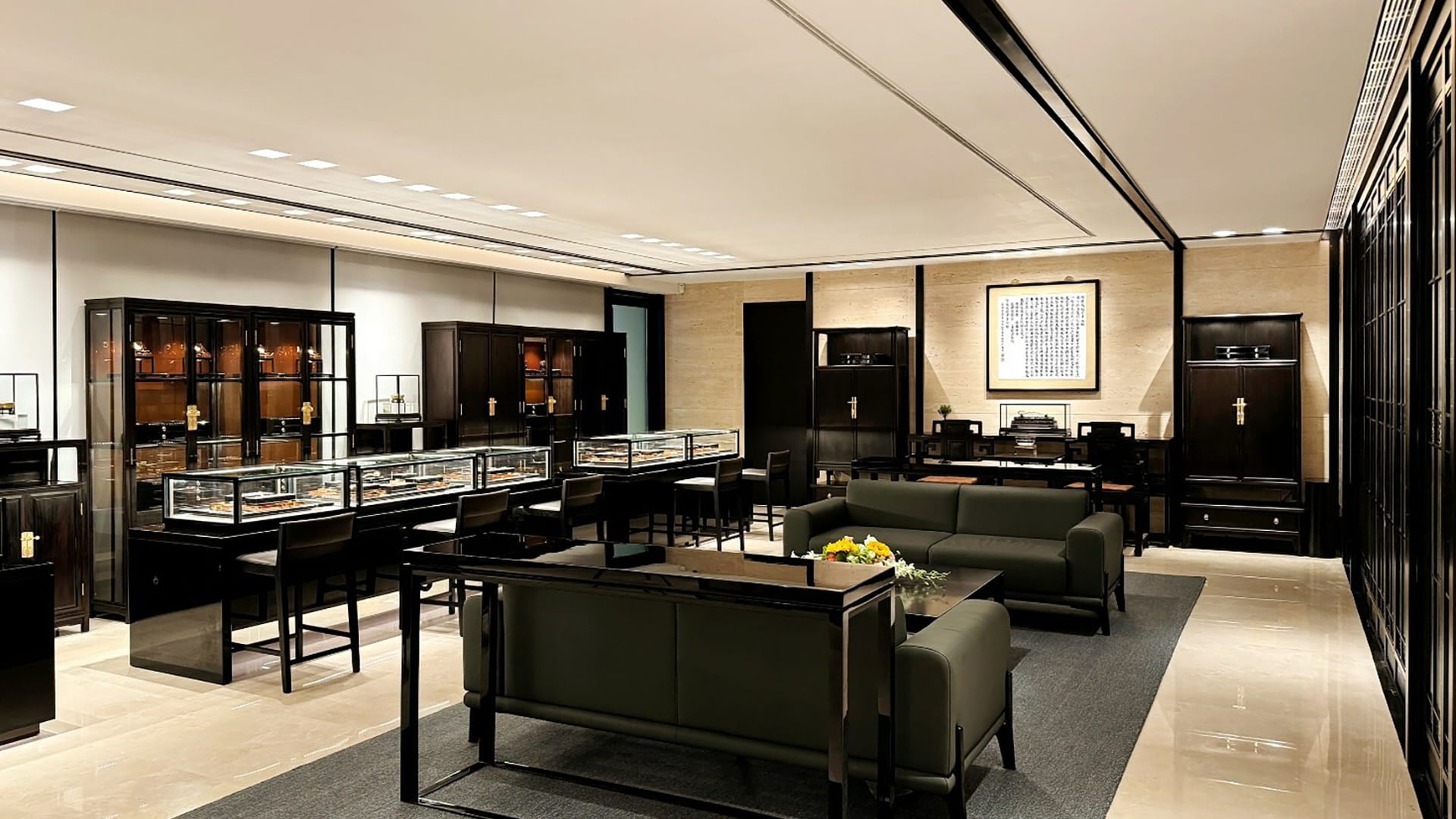
From this perspective, Laopu Gold does not appear to be positioning itself in the mold of Hermes.
Some argue that China’s market is ready for a domestic high-end brand. However, Hermes took 188 years to evolve from a Paris saddlery into a global luxury leader, supported by sustained narrative building and cultural influence.
At least for now, Laopu Gold appears to be an early-stage contender, edging closer to the high-net-worth segment. The rest will depend on time.
KrASIA features translated and adapted content that was originally published by 36Kr. This article was written by Xie Yunzi for 36Kr.
Note: HKD, RMB figures are converted to USD at rates of HKD 7.84 = USD 1 and RMB 6.85 = USD 1 based on estimates as of April 29, 2026, unless otherwise stated. USD conversions are presented for ease of reference and may not fully match prevailing exchange rates.